Why your AI prospecting workflow in Claude or ChatGPT stalls

A chat-based AI prospecting workflow stalls at team scale for five reasons: someone has to start every run, the assistant forgets what was already researched and sent, each rep prompts differently, nothing enforces approval or an audit trail, and the strongest model does work a cheap one could do. Getting the team onto Claude or ChatGPT was the right first step. Closing those five gaps is the next one.
Key takeaways
- Chat assistants are reactive by design. A production system runs on a schedule and has work ready by morning.
- Inconsistent output across reps is not a training problem. It is what happens when the playbook lives in N personal prompts.
- Your best prompt is already most of a playbook: write it down, schedule it, log it.
You've already done the hard part
Most sales teams are past "should we use AI?" According to Salesforce's 2026 State of Sales report (a vendor survey of 4,050 sales professionals), 54% of sales teams already use AI agents, and wealth management is the number one industry using AI agents for sales, with financial companies taking three of the top five spots.
The most AI-forward sales teams we meet have a good setup already. The whole team is on Claude, connected to HubSpot and the SEC's adviser data on IAPD. Someone on the team has built a prospecting agent that writes sequences, and maybe another that makes custom collateral for engaged prospects. It works. But every workflow has to be kicked off by a person, and each rep gets different output because each rep prompts differently. The sales leader has a specific way things should be done, every time, by everyone.
That is not a failure of DIY. It is the ceiling of a chat interface.
What are the five gaps in a chat-based AI prospecting workflow?
1. Trigger: someone has to start it
A chat assistant does nothing until a person types, so the workflow runs when a rep remembers to run it. Meanwhile advisers file Form ADV amendments, funds file Form D, and holdings change. A production system runs overnight on a schedule, so the research, scoring and first drafts are waiting when the rep logs in.
2. Memory and state: what was already done
A chat session knows what is in the chat. It does not reliably know that a colleague researched this firm last Tuesday or that a draft went out Thursday. State has to live outside the conversation: what was researched, drafted and sent, and by whom. Without it you get repeated work and repeated outreach. Salesforce's report lists duplicate data as the second most common data issue among teams using AI agents, and 46% of sales pros with agents say data quality problems hurt their sales.
3. Consistency: one playbook vs N personal prompts
Ten reps using Claude for sales prospecting means ten prompts, ten readings of your ideal customer, and ten tones of voice. The 2024 Microsoft and LinkedIn Work Trend Index found that 78% of AI users bring their own AI tools to work. That survey is not sales-specific, but the pattern holds: when everyone brings their own setup, the leader's method gets diluted one rep at a time.
4. Governance: approval, compliance, audit trail
If your distribution team includes registered reps, FINRA Regulatory Notice 24-09 is clear that its rules are technology neutral: Rule 2210 applies to communications whether a person or an AI wrote them, and Rule 3110 supervision still applies. A paste from a chat window leaves no record of which inputs, rules or approvals produced the email. A production system checks drafts against your rules first and keeps the trail. We go deeper on this in AI guardrails for BDR outreach.
5. Cost: the strongest model doing cheap work
In a chat app, reps tend to use one model, often the most capable, for everything. Pulling a filing or checking a draft against exclusions does not need a frontier model. On Anthropic's published pricing (checked October 2026), Claude Opus 5.5 lists at $4 input and $20 output per million tokens, while Claude Haiku 5.5 lists at $0.10 and $0.50 for prompts up to 100K tokens: a 40x gap. More on routing in AI prospecting token costs and model routing.
Chat assistant vs scheduled AI prospecting system
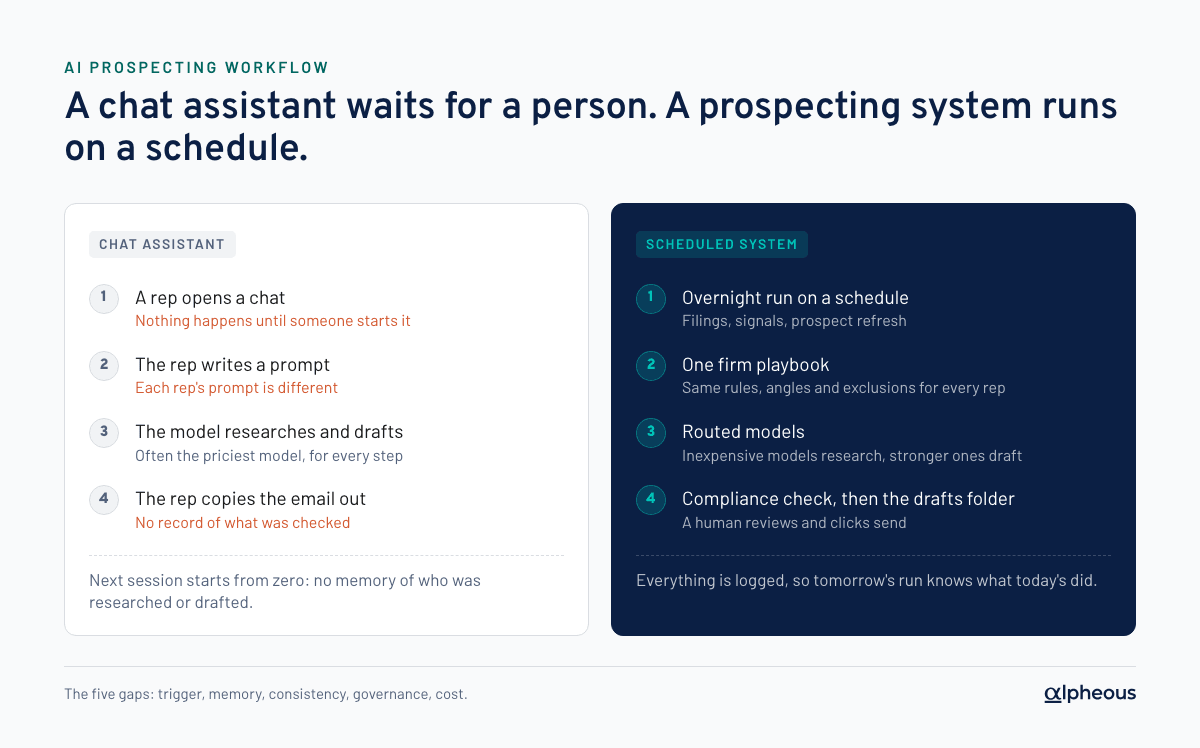
| Chat assistant (Claude, ChatGPT) | Scheduled AI prospecting system | |
|---|---|---|
| Who starts it | A rep, when they remember | A schedule, overnight |
| Memory | The current conversation | A shared record of research, drafts and sends |
| Playbook | Each rep's personal prompt | One set of firm-level rules |
| Data inputs | Whatever the rep pastes or connects | Filings, CRM and signals pulled on a fixed cadence |
| Output | Varies by rep and by day | Same process for every rep |
| Approval | Copy, paste, send | Draft lands for a human to review and send |
| Audit trail | Chat history, if anyone keeps it | Logged inputs, rules applied and outcomes |
| Model cost | One model for every step | Cheap models for research, strong models for drafting |
You've outgrown ad hoc AI prospecting when...
- The best results come from one or two reps, and nobody else can reproduce them.
- You have written the same "here's how I want it done" instructions in Slack more than twice.
- Reps ask "has anyone already contacted this firm?" and the answer requires a meeting.
- A filing or signal you cared about sat unnoticed for a week because nobody ran the search.
- Compliance reviews outreach after it is sent, or not at all.
- You cannot say which inputs or rules produced a given email.
- Your AI spend is a set of individual subscriptions with no view of what each task costs.
- Your CRM has fewer AI-researched fields than your reps' chat histories do.
If four or more are true, your AI prospecting tools are doing a system's job without being one.
How do you turn your best prompt into a team playbook?
You can do this with or without new software. It is the honest answer to how to use AI for sales prospecting as a team rather than as a set of individuals.
- Write the rules down. Take your best prompt and pull out every judgment in it: who counts as a fit, which angle fits which segment, tone, length.
- Name the inputs. List exactly which data the workflow reads: CRM fields, Form ADV items, recent filings, the prospect's website. Anything a rep pastes in should be pulled automatically.
- List the exclusions. Existing clients, open opportunities, contacts reached in the last 30 days, firms owned by another rep's territory, anyone who opted out. This is where ad hoc workflows quietly fail.
- Define the approval steps. Decide who reviews what, and which compliance rules a draft must pass. Make "draft, then a human sends" the default.
- Run it on a schedule. Nightly for signals, weekly for list refreshes. It runs whether or not anyone remembers.
- Log every run. Record inputs, rules applied, output and approver. Write useful results back to your CRM so the next run, and the next rep, starts from what is known.
Written this way, the playbook belongs to the team, not the person who wrote the prompt, and you change it in one place.
How Alpheous runs this for you
Alpheous is AI infrastructure for financial services distribution: a single-tenant appliance installed at your firm and managed remotely. It closes the five gaps:
- Trigger: overnight runs handle filings ingest (Form ADV, 13F, Form D), signal scans, a prospecting refresh and a weekday morning brief. Nobody kicks it off.
- Consistency: drafting rules, angles, compliance rules and signal thresholds are firm-level settings, so every rep gets the same process.
- Governance: drafts are checked against your configured compliance rules, failing closed, and land in the rep's own Gmail or Outlook drafts folder. Alpheous never sends email on its own.
- Memory: scores and signals are written back to HubSpot custom properties, and a contact drafted through Alpheous is not suggested again for 30 days.
- Cost: inexpensive models do research and checks, stronger models draft, and you run on your own model provider keys.
See how it works, take the product tour, or book a call to walk through your setup.
FAQ
Can I use Claude for sales prospecting across a whole team?
Yes, and many teams already do. The limit is the interface, not the model: each rep runs their own sessions with their own prompts, so output varies and nothing runs unless someone starts it. To scale, move the playbook into shared rules and run it on a schedule.
Is ChatGPT good enough for sales prospecting?
ChatGPT and Claude are both strong at research and drafting when a person drives them. As a team system they lack a schedule, shared memory of what was already done, and an approval and audit trail. Those gaps come from the chat format, not the model.
What is an AI prospecting workflow?
An AI prospecting workflow is a repeatable sequence in which AI gathers data on prospects, decides who is worth contacting, and drafts outreach under defined rules. A production version runs on a schedule, records what it did, and routes every draft to a human for approval before anything is sent.
What should an AI prospecting agent connected to HubSpot write back?
It should write back what the next rep or run needs: fit or priority scores, the signals behind outreach, and when a contact was last researched or drafted. Storing those in HubSpot properties lets your existing workflows and reports use them, instead of leaving them in a chat history.
How do I stop each rep getting different results from the same AI prompt?
Turn the prompt into written rules, named inputs, exclusions and approval steps, then run it centrally instead of letting each rep paste their own version. Different results usually mean different prompts, context or models. One shared playbook fixes all three.