AI guardrails for BDR outreach: stop the wrong email going out
AI guardrails for BDR outreach are the rules, checks and release steps that sit between a junior rep's AI-drafted email and a prospect's inbox. They stop the wrong person, the wrong product or an invented fact from going out. Training helps at the margin, but only guardrails built into the workflow still hold when a BDR is moving fast, which is always.
Key takeaways
- AI made your BDRs faster at research and drafting. It also made their mistakes faster.
- Six failures cause most bad outreach: wrong person, wrong fit, wrong facts, stale data, non-compliant language and a colleague's duplicate touch.
- Guardrails work in three layers: data (who may be contacted), generation (what the AI may say) and release (what must happen before send).
Why do AI-assisted BDRs email the wrong person?
The pattern is common across firms that sell to advisers and fund managers. A sales leader hires BDRs to do the research-heavy groundwork senior sellers won't do, gives them Claude or ChatGPT, and the hit rate goes up. Then the misses start: an email to the wrong contact at a firm the team is already working, a pitch for a service the prospect could not possibly use. Selling chicken to a vegetarian. The manager finds out after it has gone out.
That isn't the model's fault. BDRs are early in their careers and measured on activity, so they optimise for speed. Claude or ChatGPT drafts fluently with no idea of your exclusion list or which colleague is already talking to the firm. And fluent prose hides mistakes: a careless email used to look careless.
Why system guardrails beat more training for junior SDRs
The Bridge Group's 2025 SDR Metrics report puts average SDR tenure at 1.9 years, ramp at 3.0 months and median annual attrition at 40%. On a team of ten, that is roughly four new people a year. Whatever judgment you coached into last year's BDRs left with them.
A rule in the system does not leave. Write the judgment down once and every rep, including Monday's new hire, works inside it.
The cost of a miss is real. Gartner reported in 2025 that 73% of B2B buyers actively avoid suppliers who send irrelevant outreach. When your market is a finite list of advisers and fund managers, a firm you annoy this quarter is hard to approach next year.
The six common SDR outreach mistakes, and the guardrail for each
| Failure | What it looks like | Usual cause | Guardrail |
|---|---|---|---|
| Wrong person or role | Pitching an analyst when the COO buys | AI picks the first name it finds | Approved buyer titles per product |
| Wrong fit | Pitching private fund services to an adviser with no private funds | No written fit criteria | Fit rules and exclusions applied before the list |
| Wrong or invented facts | "Congratulations on passing $2B" when they haven't | The model fills gaps from memory | Grounding in approved sources; no unsourced numbers |
| Stale data | Citing a role or asset figure that changed | CRM decay; annually updated filings | Freshness windows; re-check before drafting |
| Non-compliant language | Promissory or performance-style claims | Nobody reviews AI phrasing | Rules-based compliance check that fails closed |
| Duplicate touch | Two reps email the same COO in one week | No shared view of who is working the account | Check CRM activity before drafting; suppression window |
Most of these are not writing problems. They are targeting and process problems that show up in writing.
A three-layer model of AI guardrails for BDR outreach
An AI guardrail is a constraint the system enforces, rather than one that depends on a rep's judgment in the moment.
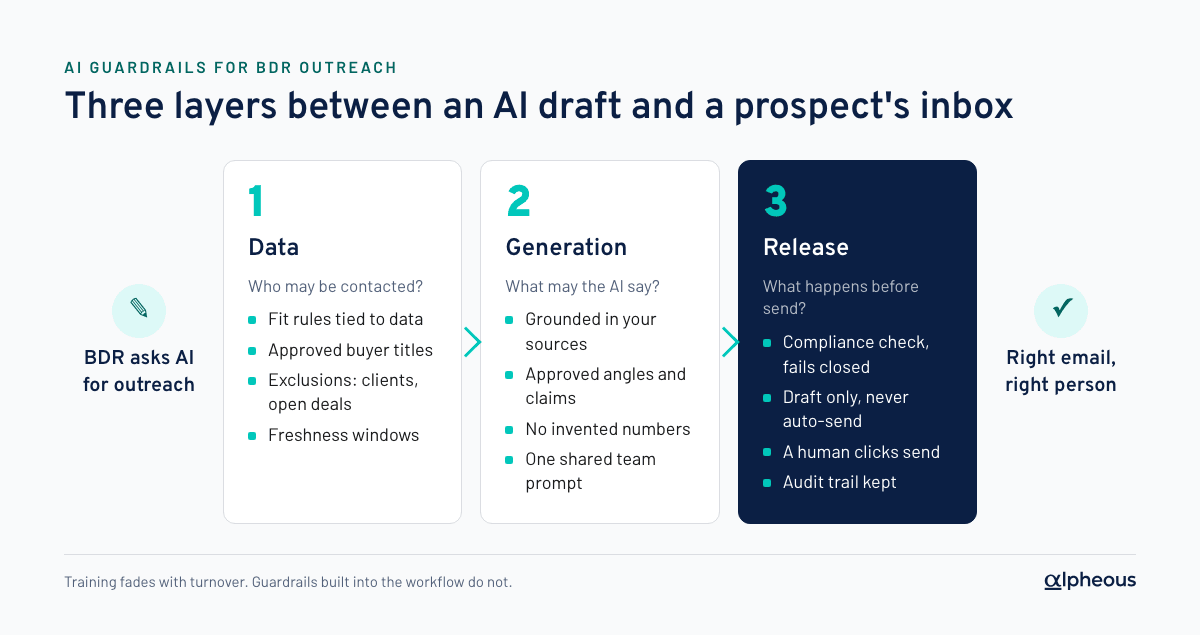
Layer 1: data guardrails (who may be contacted)
- Fit rules. Three to five criteria per product, each tied to a checkable data point. For a private fund service, Form ADV Item 7.B shows whether an adviser manages private funds at all (Part 1A).
- Role targeting. Name the titles that buy each product, and the ones that never do.
- Exclusions. Current clients, open deals owned by an AE, partners, do-not-contact.
- Freshness. Advisers don't have to update assets under management or private fund data between annual amendments (General Instruction 4), so a filed figure can be nearly a year old. Contact data decays too: HubSpot, citing MarketingSherpa, estimates about 22.5% a year.
Layer 2: generation guardrails (what the AI may say)
- Grounding. Grounding means the model may only state facts from sources you supplied (the CRM record, a filing, an approved fact sheet), not from its own memory.
- Approved angles and claims. A short library of positioning and proof points the firm has signed off.
- No invented numbers. If a figure can't be traced to a source, it stays out.
- One shared prompt. Every BDR runs the same instructions, not a personal prompt tuned for speed.
Layer 3: release guardrails (what must happen before send)
- Compliance check. The draft is checked against written rules; if the check can't run, nothing moves forward. That is "fail closed".
- Draft-only. AI output lands as a draft. The tool never sends.
- A human clicks send. Every time.
- Audit trail. Who drafted it, from which sources, which check passed, who sent it.
What does FINRA Rule 2210 say about AI-written emails?
If your BDRs or wholesalers are registered representatives, read FINRA Regulatory Notice 24-09. FINRA says its rules are "technology neutral" and apply to generative AI, including Rule 2210 on communications with the public (whether a person or AI wrote them) and Rule 3110 on supervision.
So "Claude wrote it" is not a defence. Your supervisory procedures need to cover how an AI-drafted email was produced, not just what it says.
Isn't editing Claude or ChatGPT sales emails enough?
HubSpot's State of AI in Sales found that 47% of sales professionals use generative AI to help write outreach, and 98% make at least some edits to AI-generated text. Good instinct. Still not a guardrail.
An edit is a person in a hurry reading prose that sounds right. It catches tone. It rarely catches a wrong contact, a stale asset figure or a colleague's open thread, because none of those are visible in the text.
A BDR guardrail checklist you can implement this quarter
All of this works with a shared Claude or ChatGPT project plus your CRM.
- Write your fit rules down, each with the public data point that proves it.
- Build the exclusion list in the CRM and make it a required check before sequence enrolment.
- Define buyer titles per product, including the titles that are never right.
- Set a freshness rule: no fact older than your window (say, 90 days) goes out without a re-check.
- Replace personal prompts with one team prompt. Attach an approved fact sheet; tell the model to use only those sources, never state a number not in them, and omit anything uncertain.
- Agree approved claims and banned phrases with compliance.
- Check account activity before drafting. A colleague's touch in the last 30 days means ask the owner first (see when multiple reps work the same account).
- Turn off auto-send. AI output becomes a draft; a human sends.
- Spot-check weekly: five sent emails per BDR, every fact traced to its source.
- Keep the trail: save the sources and prompt behind each email.
Building the research side too? See AI prospecting workflows that scale.
How Alpheous builds these guardrails in
Alpheous builds the three layers in:
- Draft-only outbound. Drafts land in the rep's own Gmail or Outlook drafts folder. Alpheous never sends email on its own; a human clicks send.
- Compliance gating that fails closed, against rules configured for your firm (for example FINRA 2210 or SEC Marketing Rule checks, where they apply), before anything becomes a draft.
- FIT score, so reps work a ranked queue of firms that actually fit.
- Firm-level drafting rules, so every BDR gets the same angles and guardrails instead of their own prompts.
- Duplicate-draft protection: a contact drafted by anyone through Alpheous isn't suggested again for 30 days.
It runs as a single-tenant appliance inside your walls (security and compliance). Take the tour or book a call.
FAQ
What are AI guardrails for BDR outreach?
AI guardrails for BDR outreach are system-enforced rules that control who a rep may contact, what an AI-drafted email may say, and what must happen before it is sent. Unlike training, they keep working when reps turn over.
What are the most common cold email mistakes SDRs make with AI?
The six most common are emailing the wrong person, pitching a firm that doesn't fit, stating wrong or invented facts, using stale data, using non-compliant language and duplicating a colleague's outreach. Most are targeting and process failures rather than writing failures. AI makes them faster, not rarer, unless the workflow checks for them.
Does FINRA Rule 2210 apply to emails written with ChatGPT or Claude?
Yes. FINRA Regulatory Notice 24-09 says FINRA's rules are technology neutral, and Rule 2210 applies to communications with the public whether a person or AI generated them. Firms also need Rule 3110 supervision that covers how AI-assisted communications are produced.
AI SDR vs human SDR: which needs more guardrails?
Both need the same guardrails, because the failures come from targeting, data and process rather than from who typed the email. An AI SDR that sends on its own removes the last human check, so the release layer matters most there. A human SDR using AI keeps that check but still needs data and generation guardrails.
Is editing AI-generated sales emails enough to prevent mistakes?
No. Editing catches tone and obvious errors, but rarely a wrong contact, an outdated figure or a colleague's open conversation, because none of those show in the text. HubSpot found 98% of sales professionals edit AI output, which is a good habit but not a substitute for checks built into the workflow.