How to stop multiple sales reps contacting the same account

Multiple sales reps contacting the same account is rarely a people problem; it is an ownership problem. It happens when ownership lives on the contact while the buyer is the firm, when the CRM holds two records for one company, and when reps prospect from lists and tools that never check recent activity. The fix is written rules of engagement plus a company-level owner in HubSpot.
Key takeaways
- Own the firm, not the person: the HubSpot company owner is the source of truth.
- Duplicate company records create two owners for one firm. Merge them on a schedule.
- Write down your sales rules of engagement: how a claim is made, how long it lasts, and what happens to inbound.
- Check recent activity on the company record before anyone enrolls a contact in a sequence.
- Report monthly on companies touched by more than one owner.
Why does it hurt more in financial services?
Ask a sales leader with a BDR team what drives them crazy, and two reps working the same firm at the same time is near the top of the list. When you sell to investment advisers and fund managers, the buyer is usually a small firm where the founder, the COO and the CCO sit a few feet apart and compare notes. Two emails from the same vendor in one week don't look like persistence. They look like a vendor that can't run its own house. That is a bad look for anyone selling operations, compliance or administration.
Buyers punish this. Gartner reported in 2025 that 73% of B2B buyers actively avoid suppliers who send irrelevant outreach. A second, uncoordinated email from a colleague is irrelevant by definition: it ignores the conversation your company is already having. And in a small market, a burned account doesn't come back next quarter.
Why are multiple sales reps contacting the same account?
Collisions have predictable causes, and most teams have several at once.
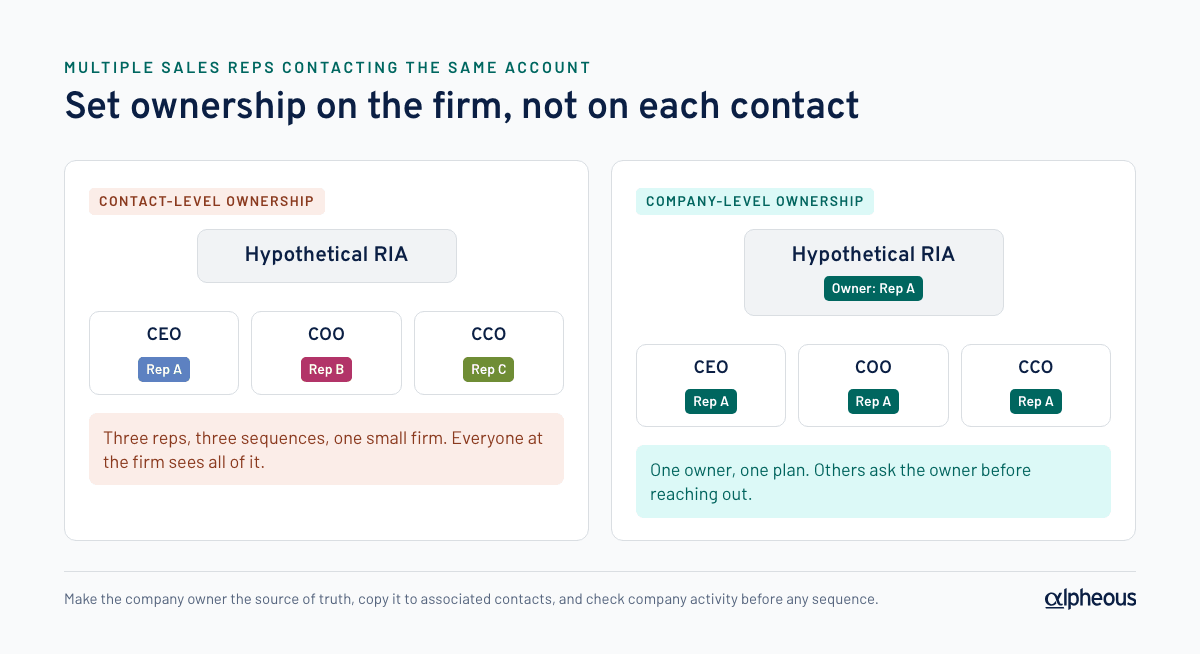
Ownership is set on the contact, but the buyer is the firm
HubSpot has an owner on each contact and a separate owner on each company. If reps claim contacts one at a time, one rep can own the CCO while a colleague owns the COO, and both feel entitled to email.
Duplicate company records
One firm, two company records (a legal name and a trading name, or one record from an email domain and another from a list import). Each gets its own owner, and each owner sees a clean history. The Salesforce State of Sales report ranks duplicate data as the second biggest data issue for sales teams using AI agents, behind manual errors.
Sequences enrolled independently
Sequences are enrolled contact by contact. Enrolling one person won't tell you a colleague enrolled her boss last Tuesday.
Lists that live outside the CRM
Reps pull lists from a data vendor, a conference attendee sheet or a shared spreadsheet. If they prospect before checking the CRM, ownership never enters the picture.
AI tools that draft without checking activity
A rep who drafts in ChatGPT or Claude gets a fluent email with no idea what the firm has already heard from you. I cover the wider set of controls in AI guardrails for BDR outreach.
Territories drawn by geography, firms spread across states
Territory models are now the norm: The Bridge Group's 2025 SDR research found 82% of SDRs are aligned to AE territories, up from 56% in 2018. But many advisers and fund managers have offices in several states. If territories follow the contact's location, the Boston office and the Denver office of one firm land with two reps.
Sales rules of engagement: a template you can adopt
Sales rules of engagement are the written policy for who may contact which account, when, and how disputes get settled. Here is a starting point. The defaults are my suggestions; tune them to your sales cycle.
| Rule | Suggested default | Why it matters |
|---|---|---|
| Who owns a firm | The HubSpot company owner. One owner per firm. | Ownership at the firm level matches how the buyer actually decides. |
| How ownership is claimed | Set the company owner before the first touch. Unowned firms go to the territory owner of the firm's principal office. | Claiming after the email is how fights start. |
| How long a claim lasts without activity | 30 days, then the firm returns to the territory pool. | Stops reps from parking accounts they never work. |
| What counts as activity | A logged one-to-one email, a connected call, a meeting, or an active sequence enrollment. Opens and page views don't count. | Keeps claims tied to real effort. |
| How to hand off | The current owner reassigns the company, writes a short note, and unenrolls any active sequences. | The new owner starts with context, not a cold restart. |
| What happens with inbound | Inbound goes to the company owner if the claim is live; otherwise to the territory owner. | A demo request should not be a race. |
| Multi-product firms | One relationship owner. Product specialists come in through that owner, never with a cold first touch. | Two products should never mean two vendors in the buyer's eyes. |
| Disputes | The sales manager decides within one business day. | A quick, boring decision beats a long, political one. |
Publish it and enforce it the first time someone tests it.
HubSpot CRM hygiene checklist
Rules only work if the CRM reflects them. This is the checklist I'd run in any portal where reps keep colliding.
- Make the HubSpot company owner the source of truth. Every prospect firm gets a company owner. Use HubSpot territory management or lead assignment rules to set the default; the company owner field is the final word.
- Keep contacts associated with their company, and copy the owner down. Unassociated contacts are invisible to company-level rules. A workflow that copies the company owner to every associated contact keeps lead assignment in HubSpot consistent.
- Merge HubSpot duplicate companies regularly. Run duplicate management monthly and after every large list import. Decide in advance which owner survives a merge.
- Check recent activity on the company record before enrolling anyone in a sequence. Open the company, look at the last 30 days, then enroll. If a colleague touched the firm, talk to them first.
- Report on companies touched by more than one owner in 30 days. Build a report of companies with logged activity from two or more users in a rolling 30-day window. It's the closest thing you'll have to a collision rate.
How do you handle firms with offices in several states?
Assign by the firm, not the office. Account mapping is the work of charting which offices, people and relationships belong to one target firm, and who on your team owns each. Map before you cut territories, then route every office to the owner of the principal office. Branches become contacts under one company record, not separate accounts.
How Alpheous handles ownership
We built Alpheous, an on-premise AI appliance for financial services distribution, with this problem in mind. Admins assign reps to territories by state, and optionally by product, and signal routing and suggested outreach respect the owner. Suggested outreach only shows a rep the contacts that rep owns in HubSpot. When anyone drafts to a contact through Alpheous, that contact isn't suggested again for 30 days.
Everything is draft-only: drafts land in the rep's own Gmail or Outlook drafts folder, and a person clicks send. Alpheous doesn't lock a firm or replace your rules of engagement; it makes them easier to follow. Take the tour or book a call to see it.
FAQ
What are sales rules of engagement?
Sales rules of engagement are a written policy that says who may contact which account, how a rep claims ownership, how long a claim lasts without activity, and how disputes are settled. Their purpose is to stop multiple reps contacting the same account and to settle conflicts quickly.
How do I stop two reps from emailing the same company in HubSpot?
Make the HubSpot company owner the single source of truth and use a workflow to copy it to every associated contact. Merge duplicate companies regularly, and have reps check recent activity on the company record before enrolling anyone in a sequence. Then report monthly on companies touched by more than one owner in 30 days.
Should HubSpot ownership be set at the company or the contact level?
Set ownership at the company level when you sell to firms, because the firm makes the buying decision. Contact-level ownership lets two reps each own a different person at the same firm and both reach out. Copy the company owner down to contacts with a workflow so both levels agree.
How often should you merge duplicate companies in HubSpot?
Monthly is a sensible default for most sales teams, plus a pass after every large list import. Duplicate company records are a common cause of collisions, because each record can carry its own owner and its own activity history.
How long should a rep keep an account without any activity?
Thirty days is a practical starting point for most B2B teams, after which the account returns to the territory pool. Define activity narrowly: logged emails, connected calls, meetings or an active sequence, not email opens.