The SEC registration threshold for RIAs is a sales trigger
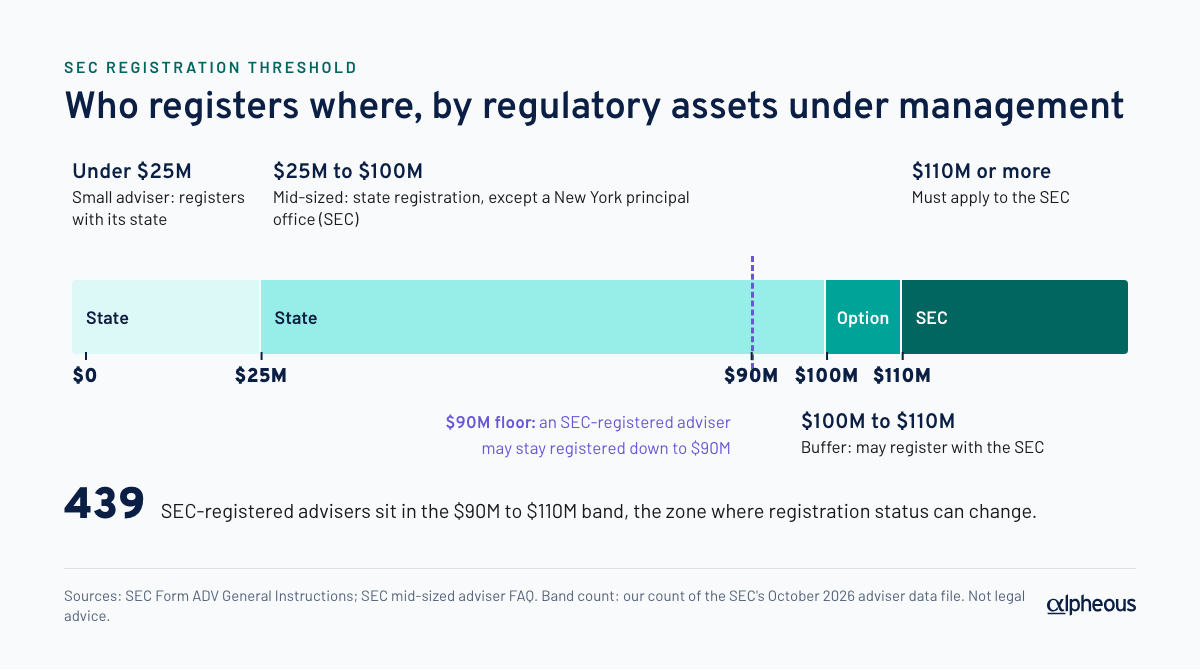
The SEC registration threshold for investment advisers is $100 million of regulatory assets under management (RAUM). Below $100 million, an adviser generally registers with its state. Between $100 million and $110 million it may register with the SEC, and at $110 million or more it must. An SEC-registered adviser can stay registered until RAUM falls below $90 million.
Sales teams that sell compliance and operations services watch for state-registered advisers climbing toward that line, because the switch is when a firm suddenly needs help. Spotting them is manual, the timing is guesswork, and the exact numbers are widely misremembered. So here is the precise rule and the method for finding these firms in public data. (Educational summary, not legal advice.)
What is the SEC registration threshold for RIAs?
Regulatory assets under management (RAUM) is the total an adviser reports in Item 5.F.(2)(c) of Form ADV Part 1A, and it is the number the thresholds are tested against. The bands come from the General Instructions to Form ADV (Part 1A Instruction 2, citing SEC rule 203A-1):
| RAUM band | Status | What happens |
|---|---|---|
| Under $25M | Small adviser | Registers with its state; generally barred from SEC registration unless another exemption applies |
| $25M to under $100M | Mid-sized adviser | Registers with its state, unless its home state does not require registration or does not examine it (New York) |
| $100M to under $110M | Optional zone | May register with the SEC; not yet required |
| $110M or more | Must register | Must apply for SEC registration within 90 days after filing the annual updating amendment that shows it |
| $90M or more, already SEC-registered | Buffer | May remain registered with the SEC |
| Under $90M, already SEC-registered | No longer eligible | Checks box 13 in Item 2.A and must file Form ADV-W within 180 days after fiscal year end |
The $90M-$110M buffer means a firm does not bounce between regulators every time markets move: it crosses up at $110 million and only crosses back below $90 million.
When does an RIA have to register with the SEC?
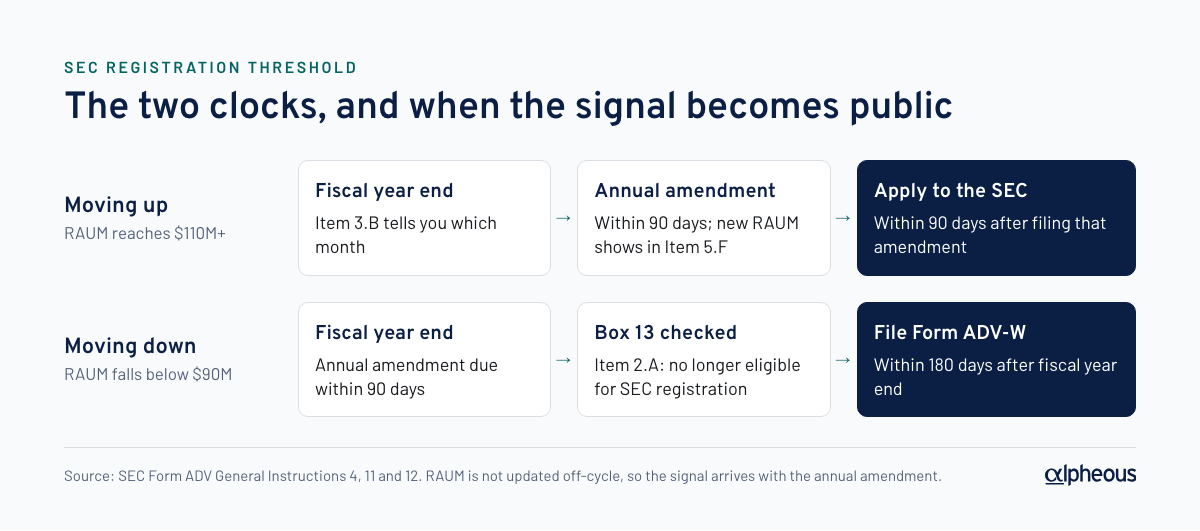
The test happens once a year, on the annual updating amendment, which every adviser files within 90 days after its fiscal year ends (General Instruction 4). If that amendment shows RAUM of $110 million or more, the adviser "must apply for registration with the SEC within 90 days after you file that annual updating amendment" (rule 203A-1(b)(1)).
For a December fiscal year end, the RAUM number lands by about March 31 and the SEC application can follow as late as about the end of June.
The reverse move has its own clock, and it is often misquoted. An SEC-registered adviser whose annual amendment shows it is no longer eligible must withdraw "within 180 days after the end of your fiscal year by filing Form ADV-W" (General Instruction 12), and stays subject to SEC regulation until it does. Some secondary sources say 90 days; the SEC says 180.
Mid-sized advisers and the New York exception
A mid-sized adviser ($25 million to $100 million) is generally prohibited from SEC registration. The SEC's FAQ on mid-sized advisers gives two exceptions: the adviser is not required to register in its home state, or it is not "subject to examination" by that state.
Which states do not examine? The FAQ's answer: "Only New York," so a mid-sized adviser based there registers with the SEC. One caution: that page was last reviewed in 2017, and I found no recent source confirming or changing it. The data fits a single-state exception: 419 SEC-registered advisers in the October 2026 SEC file check the mid-sized box.
Wyoming, which shows up in older articles, was a "not required to register" case: it had no adviser registration until July 1, 2017, after which its SEC-registered advisers moved to the state.
Other routes to SEC registration below $100 million
Item 2.A of Form ADV lists the bases for SEC registration, and several work below $100 million:
- Adviser to a registered investment company, at any size, if the fund is operational.
- Adviser to a business development company with at least $25 million of RAUM.
- Pension consultant to plans holding at least $200 million in aggregate.
- Related adviser under common control with an SEC-registered adviser and sharing its principal office.
- Expecting eligibility within 120 days, such as a newly formed adviser.
- Multi-state adviser required to register in 15 or more states.
- Internet adviser. Amendments adopted in March 2024 require advice to all clients exclusively through an interactive website; advisers no longer eligible had to file Form ADV-W by June 29, 2025.
- SEC exemptive order.
How many advisers sit near the line?
By our count of the SEC's October 2026 adviser data file, 17,210 advisers are SEC-registered, and 439 of them report RAUM between $90 million and $110 million, inside the buffer band. Another 71 had checked box 13, meaning they are no longer eligible for SEC registration. (The SEC notes it cannot guarantee the accuracy of Form ADV data.)
On the state side, NASAA's 2026 IA Section report counts 16,162 state-registered investment advisers in their home state as of December 31, 2025. That is the pool your future threshold-crossers come from.
Why the switch is a buying moment
An adviser moving from state to SEC registration gets a new primary regulator and examiner, new filing obligations, and a compliance program that has to be ready for that regulator. It is also, by definition, growing. Fresh obligations plus a bigger budget is what makes the moment worth watching for:
- Compliance consultants and outsourced CCO services: the registration work and the program build.
- Fund and middle-office operations providers: a firm that crossed $110 million may be growing faster than its back office.
- Technology vendors to RIAs: tools that suited a small state firm get re-evaluated.
- Custodians: a growing adviser is a growing relationship.
How do you find advisers about to cross the threshold?
Everything you need is public, just spread across forms and filing dates:
- Build the state-registered list from IAPD. Investment Adviser Public Disclosure covers state-registered firms, their filings and brochures. The SEC's monthly bulk files cover SEC-registered and exempt reporting advisers, not state-registered ones.
- Track total RAUM in Item 5.F.(2)(c). Pick a watch band below $100 million and compare each year's figure with the last; the growth rate matters as much as the level.
- Note the fiscal year-end month in Item 3.B. The annual amendment lands within 90 days after it, so you can predict when each firm's next RAUM number appears.
- Expect the signal only with the annual amendment. RAUM does not have to be updated off-cycle, so a firm that crossed $110 million in June may not show it until next spring. Plan around the filing, not the market.
- Cross-check Item 4.E of the Part 2A brochure. It reports client assets with an "as of" date, possibly computed differently from RAUM. Treat it as a second opinion, not the test.
- Watch the Item 2.A boxes on SEC-registered firms. Box 13 means an ADV-W deadline is coming; firms in the $90M-$110M band can move either way.
- Time outreach to the clock. A firm that just reported $110 million or more has 90 days to apply. Reach out while the work is being scoped.
For the broader method (custody, private funds, CCO names and more), see how to use Form ADV for prospecting.
How to open the conversation
Lead with help, not alarm. Crossing into SEC registration is a growth milestone, and nobody wants a cold email implying trouble. Reference the public fact, acknowledge the milestone, offer something useful:
Congratulations on the growth: your latest Form ADV puts regulatory assets above $110 million. Firms at that point usually start planning the move to SEC registration. We put together a short checklist of what changes and when; happy to send it over.
Keep it short, and make sure the number you quote is the one in the filing.
Where Alpheous fits
Alpheous runs this watch overnight. It ingests Form ADV and IAPD filings on a schedule, flags asset changes and other amendments as signals, and blends them into a FIT score that ranks who to call. It drafts outreach for flagged prospects, checks each draft against your firm's compliance rules, and puts it in the rep's own drafts folder; a human clicks send. Scores and signals write back to HubSpot for your own workflows. A dedicated threshold-crossing alert is the kind of signal we are building toward.
See it on the tour, or book a call.
FAQ
When does an RIA have to register with the SEC?
An investment adviser must apply for SEC registration once its regulatory assets under management reach $110 million. The test is made on the annual updating amendment, due within 90 days after fiscal year end. The adviser then has 90 days after filing that amendment to apply.
Can an RIA with less than $100 million register with the SEC?
Yes, in specific cases. A mid-sized adviser ($25 million to $100 million) based in New York registers with the SEC, because New York is the only state the SEC lists as not examining mid-sized advisers. Other routes include advising a registered investment company, acting as a pension consultant to plans with at least $200 million, or having to register in 15 or more states.
What is the difference between $100 million and $110 million for RIA registration?
At $100 million of RAUM an adviser may register with the SEC but is not required to. At $110 million it must apply for SEC registration. Once registered, it may remain with the SEC while RAUM stays at $90 million or more.
How long does an SEC-registered adviser have to withdraw if assets fall below $90 million?
An adviser whose annual updating amendment shows it is no longer eligible must file Form ADV-W within 180 days after the end of its fiscal year. It remains subject to SEC regulation until that ADV-W is filed.
Where can I see an adviser's regulatory assets under management?
RAUM is reported in Item 5.F.(2)(c) of Form ADV Part 1A. You can look up SEC-registered and state-registered firms on the SEC's Investment Adviser Public Disclosure site, adviserinfo.sec.gov. The figure refreshes with each annual updating amendment, not mid-year.