Form ADV prospecting: how to find prospects at RIAs and funds
Form ADV prospecting means reading the SEC's adviser registration form as a sales database. Schedule D tells you who administers, audits and holds custody for each private fund. Part 1A tells you how big a firm is and how it is changing. The Part 2A brochure hints at how it operates. All of it is public, free, and refreshed at least once a year.
The best sales teams selling into this market already work this way, by hand. A managed-services firm reads brochures to guess which systems a prospect runs, since it delivers services on the client's own platform. A fund administrator reads the private fund section for each fund's administrator, hunting for, say, a small fund likely paying a large incumbent six figures a year for work a specialist could do for a fraction of that. It works. It is also slow, one firm at a time.
Key takeaways
- Schedule D Section 7.B.(1) names each private fund's auditor, prime broker, custodian, administrator and marketers: a vendor map of the market, fund by fund.
- Part 1A gives you size, growth, client mix and custody in sortable fields.
- Service-provider data only has to be updated annually, so treat it as up to a year old.
What is Form ADV, and why is it a prospecting source?
Form ADV is the registration and disclosure form investment advisers file with the SEC and the states: Part 1A is structured data about the firm, Schedule D holds the detail behind it (including every private fund), and Part 2 is narrative, with the 2A brochure for clients and 2B supplements on key staff. See the Part 1A and Part 2 forms.
By our count of the SEC's October 2026 adviser data file, there are 17,210 SEC-registered advisers; 6,079 of them advise private funds and report 67,362 private fund entries. Another 6,778 are exempt reporting advisers: private fund managers that report to the SEC without full registration and file only part of the form, including the private fund section. The SEC does not guarantee the data's accuracy, so treat it as a strong lead source, not gospel.
How do you find a private fund's administrator in Form ADV Schedule D?
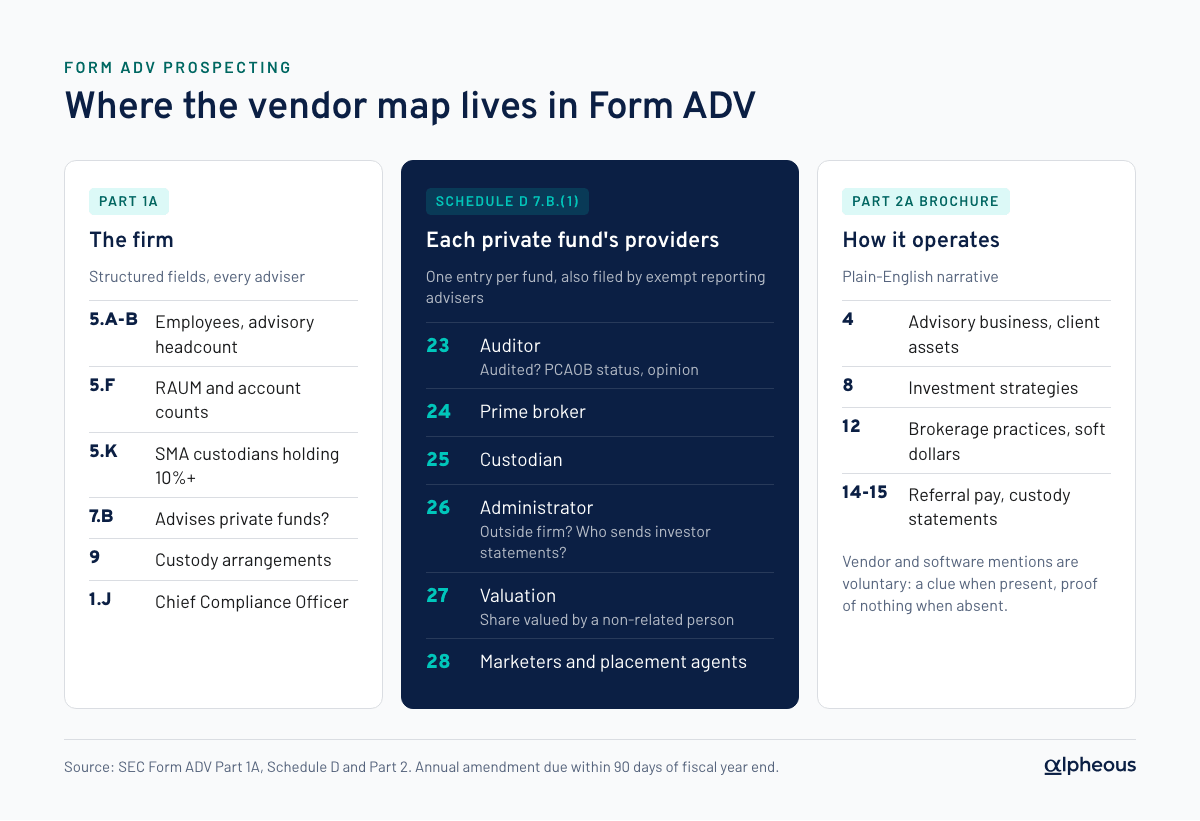
Section 7.B.(1) has one entry per private fund. Part A identifies the fund and its gross asset value (question 11); Part B, "Service Providers," is where prospecting gets specific.
| Question | What it asks | Sales angle |
|---|---|---|
| 23. Auditors | Audited? US GAAP? Auditor name, PCAOB status, unqualified opinions | Every incumbent auditor, and every unaudited fund |
| 24. Prime broker | Name, SEC number, office, and whether it also acts as custodian | The trading and financing relationship behind hedge fund operations |
| 25. Custodian | Custodians used, names, custody office location, related-person status | Custodians and custody-linked vendors map share of wallet by fund |
| 26. Administrator | Administrator other than the adviser? Name, location, related person, who sends investor statements | The core fund administrator target list, including self-administered funds |
| 27. Valuation | Share of fund assets valued by someone who is not a related person | A low share means in-house valuation: an opening for administrators and valuation providers |
| 28. Marketers | Placement agents, finders and other solicitors: name, SEC and CRD numbers, websites | Who raises capital; relevant to placement agents and compliance consultants |
Question 26 rewards a close read. A "no" on 26(a) means the adviser administers the fund itself. A related-person administrator (26(d)) is structural and rarely worth a cold call. If 26(e) says statements go to only some investors, or none, the adviser does part of that work in-house. Add gross asset value and you can rank funds by how likely they are to be overpaying or under-served.
Which Part 1A items matter for RIA lead generation?
For selling into advisers generally, these items do most of the work:
| Item | What it tells you | Who should care |
|---|---|---|
| 5.A-B | Total employees, and how many do advisory work | Outsourcers, middle office, per-seat pricing |
| 5.D | Client types, with RAUM by type | Anyone with an institutional vs retail split |
| 5.F | RAUM, discretionary vs non-discretionary, account counts | Everyone: this is your list of RIAs by AUM |
| 5.K | SMAs; Schedule D 5.K.(3) names any custodian holding 10%+ of SMA assets | Custodians, custody-integrated tech |
| 7.A | Related broker-dealers, banks, trust companies, insurers, other advisers | Channel teams; spotting an in-house competitor |
| 7.B | Whether the firm advises private funds | Fund administrators, auditors, fund compliance |
| 9 | Custody, qualified custodians, surprise exams | Auditors, custodians, compliance consultants |
| 1.J | Chief Compliance Officer name and contact | Compliance consultants and compliance tech |
| Schedules A, B | Owners and executive officers | Anyone who needs decision-makers, not just the firm |
Regulatory assets under management (RAUM) is the Item 5.F figure the SEC registration thresholds are tested against, and firms crossing them are a sales trigger in their own right.
What can the ADV Part 2A brochure tell you?
The Part 2A brochure is the plain-English disclosure an adviser gives clients, with fixed headings. The useful items are 4 (advisory business, plus client assets with an "as of" date), 8 (investment strategies), 12 (brokerage practices, including the types of products and services bought with soft dollars) and 14 and 15 (benefits from non-clients, referral pay, custody statements).
The honest caveat: no Part 2A item requires an adviser to name its CRM, portfolio, trading or reporting software, and Item 15 does not require the custodian's name. Some firms mention platforms under Item 12 or 14; many do not. Treat vendor and technology mentions as voluntary and inconsistent: a good opener when present, proof of nothing when absent.
How do you get the data?
- IAPD (Investment Adviser Public Disclosure): look up SEC- and state-registered firms and read their filings and brochures.
- The SEC's monthly adviser files: the practical Form ADV data download, one registered and one ERA file per month back to July 2006. They do not carry every field, and full Schedule D detail is not in them.
- The Form ADV archive: fuller data and brochure PDFs, but only for filings before January 1, 2025, and no state-registered advisers. The SEC says 2025 onward is on IAPD.
- Exempt reporting advisers file Schedule D 7.B.(1) too, so their funds disclose service providers just like registered advisers' funds.
How fresh is Form ADV data?
Every adviser files an annual updating amendment within 90 days of its fiscal year end (General Instruction 4), and Item 3.B shows which month that is. For the many firms on a December year end, that means a wave of filings by about March 31.
Between annual filings, advisers must amend promptly if Items 1, 3, most of 9, or 11 become inaccurate, or if Items 4, 8 or 10 become materially inaccurate. RAUM, Item 2 and private fund data in Schedule D 7.B do not have to be updated off-cycle. So:
- Service-provider data can be up to about a year old. Confirm the incumbent before you pitch against it.
- An off-cycle amendment is itself a signal that contact details, custody or disciplinary history changed.
- Filings are still a sturdier signal than anonymous web-visit intent in this market.
The Form ADV prospecting playbook, by seller type
- Fund administrators. Filter 7.B.(1) entries where 26(a) is "no" or 26(e) is "some" or "no." Drop related-person administrators. Sort by gross asset value and flag small funds served by large incumbents, the likeliest pricing gap. A low third-party valuation share (question 27) is a second opening.
- Auditors. Start with funds not audited (23(a)(1)) or not sending audited statements to investors (23(g)). Map incumbent auditors across each adviser's funds.
- Compliance consultants. Reach the CCO by name through Item 1.J. Watch for firms nearing SEC registration, adding private funds, using third-party marketers (question 28), or amending disciplinary items off-cycle.
- Outsourcers and middle office. Compare RAUM with advisory headcount: lean teams carrying rising assets are stretched. Add client mix (5.D), then read Part 2A Items 4, 8 and 12 for platform clues.
- Custodians and tech vendors. Use Schedule D 5.K.(3) and questions 24 and 25 to map custody fund by fund, and Item 7.A to spot affiliated banks that already own the relationship. Brochure platform mentions are a bonus, never the filter.
How Alpheous runs this overnight
By hand, the playbook works for twenty firms, not thousands. Alpheous is AI infrastructure for financial services distribution, installed on-premise at your firm. Every night it ingests Form ADV and IAPD filings and flags changes in assets, custody, disclosures, office locations and amendments. Those signals feed a FIT score and a ranked queue of who to call, written back to HubSpot custom properties so your own workflows can use them. Fund-by-fund administrator tracking from Schedule D is the kind of signal we are building toward.
To see it on your market, book a call or take the tour.
FAQ
What is Form ADV Schedule D?
Schedule D holds the detail behind the items in Form ADV Part 1A. Section 7.B.(1) has one entry per private fund, including gross asset value and service providers: auditor, prime broker, custodian, administrator, valuation and marketers. Both SEC-registered advisers and exempt reporting advisers file it.
How do I find which administrator a private fund uses?
Open the adviser's latest Form ADV on IAPD (adviserinfo.sec.gov) and go to Schedule D, Section 7.B.(1), question 26 for the fund. It shows whether the fund uses an outside administrator, who it is, and who sends investor statements. Private fund data only has to be updated annually, so the answer can be up to about a year old.
Where can I download Form ADV data in bulk?
The SEC publishes monthly files of registered and exempt reporting advisers back to July 2006, but they omit some fields, including full Schedule D detail. The SEC's fuller Form ADV archive covers only filings before January 1, 2025. Data from 2025 onward is available through IAPD.
How can I get a list of RIAs by AUM?
Download the SEC's monthly registered-adviser file and sort by regulatory assets under management, which advisers report in Item 5.F of Part 1A. RAUM only has to be updated with the annual amendment, so check the filing date.
How often do advisers update Form ADV?
Advisers file an annual updating amendment within 90 days of fiscal year end, so December year-end firms file by about March 31. Some items, including contact details and custody, must be amended promptly when they become inaccurate. Assets under management and private fund data, including Schedule D service providers, only have to be updated annually.