HubSpot buyer intent in financial services: what works instead

HubSpot buyer intent does what it says: it shows which companies visited your site or researched your topics in the last 90 days. For firms selling to investment advisers and fund managers, it is a weak trigger alone: it names companies, not people, misses home-office traffic, and cannot tell a buyer from a job seeker. Use it as a tie-breaker; take your triggers from filings and relationships.
Key takeaways
- Research intent and visitor intent both identify companies, not people.
- Reverse IP lookup rarely resolves home broadband, and financial activities had the highest telework rate of any major US industry in June 2026.
- A visit is curiosity. A Form ADV change, a Form D filing or a new hire is a reason.
- Route outreach only when intent overlaps with fit and a second, harder signal.
- Write better signals into HubSpot properties so your existing workflows can act on them.
How does HubSpot buyer intent work?
I've been a HubSpot partner for more than 12 years, and I like this feature. Know exactly what it does before deciding how much weight to give it. Per HubSpot's knowledge base article Use buyer intent:
- Research intent surfaces companies researching topics across the web.
- Visitor intent surfaces companies that meet criteria you set, based on visits to specific pages of your own site.
- Identification is company-level. The tracking code collects website activity and IP addresses, and buyer intent "connects anonymous web visitors to known companies' IP addresses." Activity is stored as company-level website activity.
- The window is 90 days. Timeframes run "within the last 90 days", and subdomain activity rolls up to the root domain.
- Plans and credits. It is available on Starter, Professional and Enterprise. Viewing more than 20 companies per view uses HubSpot Credits, and tracking a company costs 10 credits.
Underneath most website visitor identification tools sits reverse IP lookup: matching a visitor's IP address to the organization that owns it. A company network yields a company name; a home broadband connection usually yields nothing useful.
Why does visitor intent underperform with advisers and fund managers?
A familiar story among firms that sell to advisers: the team switches on buyer intent, builds a nurture workflow for site visitors, and the results are thin. That is not a HubSpot bug; it is a fit problem, in four parts.
Many of your buyers are small firms
Advisers with under $100M of regulatory assets under management generally register with their state rather than the SEC (Form ADV General Instructions), and NASAA counts 16,162 state-registered advisers in its 2026 annual report. Leadfeeder's documentation notes that markets with many small companies and more ISP traffic see lower identification.
The buyers work from home
The Bureau of Labor Statistics reports that 52.5% of workers in financial activities teleworked in June 2026, the highest share of any major industry. My read: many of your prospects' visits come from home connections that resolve to an internet provider, not an employer. Leadfeeder is candid that "there is no way to honestly give a percentage of visitors identified" and does not show ISP visits at all. Every IP-based tool lives with this.
A company is not a person
Even a clean match tells you the firm, not who. At a 12-person RIA, the visitor might be the chief compliance officer or an intern, and your nurture email goes to whoever is in the CRM.
A visit is curiosity, not a need
People land on your site by accident, to apply for a job, to size up a competitor, or as a client looking for the login page. None of them is buying. Intent data accuracy is partly a matching question and partly a meaning question; meaning is the harder one.
Which buying signals work better in financial services?
Your prospects file things. When an adviser's assets jump, a manager launches a fund or a key person changes seats, it shows up in public records or the press, and it explains why now in a way a page view cannot. Here is how I rate the main signal types (my judgment, not a benchmark).
| Signal | Tells you who | Tells you why now | False-positive risk |
|---|---|---|---|
| Website visitor intent | Company, rarely the person | Weak: curiosity | High |
| Research intent | Company | Weak: topic interest, not a project | High |
| Email engagement | The person | Weak: attention, not need | Medium |
| Form ADV changes | Firm, plus named owners and CCO | Moderate to strong: assets, custody, office moves | Low to medium |
| 13F holdings changes | Firm | Moderate | Medium |
| Form D filings | Firm and offering | Strong: new fund, new work | Low to medium |
| BrokerCheck moves | The person | Strong: new seat, new choices | Low |
| Press and LinkedIn job changes | The person | Strong for a new decision-maker | Low to medium |
| Direct replies and meetings | The person | Strongest | Lowest |
Form ADV is the registration form investment advisers file with the SEC and the states, public on IAPD. One caution: assets are updated on the annual amendment, due within 90 days of fiscal year end, so that number can be up to a year old. More in Form ADV prospecting.
The bottom row is your own relationships. A reply, a meeting or a referral beats every inferred signal, which is why it pays to watch partners and competitors as closely as prospects (see partner and competitor monitoring).
How do you use HubSpot buyer intent signals well?
Keep the feature on. Change what it is allowed to trigger.
- Treat it as a tie-breaker, not a trigger. Between two equally good firms, the one on your site this week goes first. A visit alone never starts a sequence.
- Combine it with fit. Score firms on who they are (adviser or fund manager, asset band, private funds or not, state) before what they clicked. Intent on a poor-fit firm is noise.
- Route only when two signals intersect. Intent plus a Form ADV change, or plus a new hire, earns a rep's attention. Intent plus nothing goes in a report.
- Suppress obvious noise. Build visitor intent criteria around high-intent pages (pricing, a service page, a contact page) and leave out careers, client login and support pages. Exclude existing clients, partners and competitors by domain.
- Feed better signals into HubSpot properties. Add custom properties such as "Last Form ADV change" and "Recent Form D", so workflows trigger on a real event, with intent as one condition among several.
- Act inside the window. Buyer intent looks back 90 days; a signal that sits a month in a queue has lost most of its value.
What does signal stacking look like?
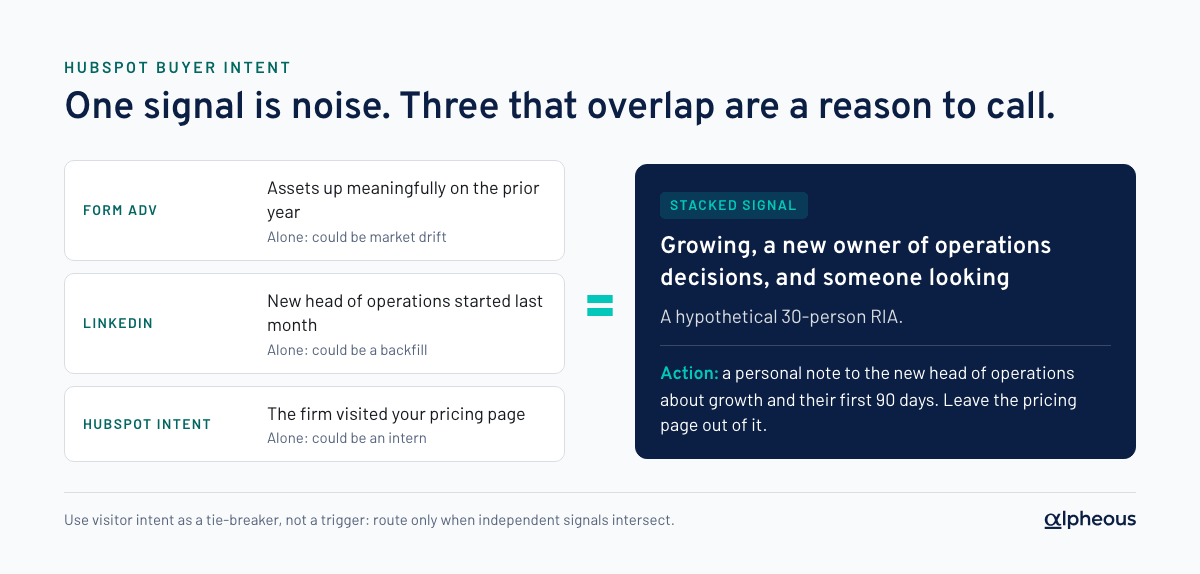
Signal stacking means acting on the overlap of independent signals instead of any single one. A hypothetical example:
- A 30-person RIA's latest Form ADV shows regulatory assets up meaningfully on the prior year.
- LinkedIn shows a new head of operations started there last month.
- HubSpot visitor intent shows the firm on your pricing page this week.
Each alone is weak: the growth might be market drift, the hire a backfill, the visit an intern. Together they say growing, a new owner of operations decisions, and someone actively looking. That is worth a personal note from the rep to the new head of operations about their growth and first 90 days. Leave the pricing page out of it; nobody wants to hear they were watched.
Where Alpheous fits
We built Alpheous to produce the signals buyer intent cannot see and hand them back to HubSpot. It runs as a single-tenant appliance inside your firm and overnight ingests Form ADV changes (assets, disclosures, custody, office moves, amendments), 13F holdings, Form D filings, BrokerCheck, press, LinkedIn changes and website changes, plus Broadridge flows for asset managers who license it.
Those feed a FIT score and a ranked Hot 100 queue blending recent contact, signal heat, meetings, deals and product fit. Scores and signals are written back to HubSpot custom properties, so your existing workflows, including that buyer intent nurture, can act on them. Outreach is draft-only: drafts land in the rep's own Gmail or Outlook drafts folder, and a human clicks send.
FAQ
Does HubSpot have intent data?
Yes. HubSpot buyer intent offers research intent (companies researching topics across the web) and visitor intent (companies visiting specific pages of your site). It is available on Starter, Professional and Enterprise plans, and larger views or company tracking use HubSpot Credits.
How does HubSpot buyer intent identify website visitors?
HubSpot's tracking code collects website activity and IP addresses, and buyer intent matches anonymous visitors to known companies' IP addresses. The result is company-level activity over the last 90 days, not the identity of the person who visited.
How accurate is reverse IP lookup for website visitor identification?
No vendor can give an honest single accuracy figure, as Leadfeeder's own documentation says. Reverse IP lookup works on corporate networks and poorly on home broadband, which matters in financial services: per the BLS, 52.5% of workers in financial activities teleworked in June 2026.
What are better buying signals when selling to investment advisers?
Public filings and relationships beat website visits. Form ADV changes, Form D filings, 13F holdings changes, BrokerCheck moves and leadership changes in the press or on LinkedIn each explain why a firm might buy now. Direct replies, meetings and referrals remain the strongest signals of all.
Should HubSpot buyer intent trigger a nurture workflow?
Not on its own. Use buyer intent as a tie-breaker, and start a workflow only when intent overlaps with good fit and a second, harder signal such as a filing change or a new decision-maker. Excluding careers, login and support pages cuts much of the noise.