Partner and competitor monitoring for sales: a weekly playbook

Competitor monitoring for sales means checking, on a fixed schedule, what your referral partners and your competitors announce, post, hire and file, then acting on each change by a rule your team agreed in advance. For firms selling to advisers and fund managers, the signals that pay are partner client wins, competitor client news, executive moves and Form ADV changes that reveal a provider switch.
The problem is the method: someone scrolls LinkedIn and press releases when they have a spare hour, and most of it gets missed.
Key takeaways
- A partner's new client is often your next prospect.
- Watch six signal types, weekly, with an owner per name and a written rule for each.
- Competitor monitoring is about timing, never trash talk.
Why does partner monitoring matter so much?
If you sell fund administration, compliance consulting, outsourcing or technology to RIAs, you sit beside other providers in every client's stack: your portfolio accounting partner, the fund lawyers, the custodian, the auditor. When one of them wins a client, that client is about to need someone like you. For many fund-services firms, partners are among the biggest sources of new business, and nobody on the team can keep up with them by hand.
The evidence is real but thin. Crossbeam's own network data (it sells partner-ecosystem software, so weigh it accordingly) found that the average lift in win rate when partners are involved in deals is 11.7%. Independent research points the same way: a 2011 Journal of Marketing study by Schmitt, Skiera and Van den Bulte of about 10,000 customers at a German bank found referred customers were worth at least 16% more than comparable non-referred ones. A consumer bank, not B2B, but the direction is consistent.
Partner-sourced revenue is revenue from deals a partner originated, as opposed to partner-influenced deals you already had in motion. The intros monitoring produces are partner-sourced, and those are worth counting.
What should competitor monitoring for sales actually watch?
Six signal types cover most of what matters.
| Signal | What it means | What to do |
|---|---|---|
| Partner client-win announcement or press release | A firm just chose a provider you work alongside and is onboarding | Ask the partner whether an intro makes sense, within a week |
| Partner or competitor LinkedIn posts and hires | New services, new regions, a team growing or shrinking | Note it on the record; a partner's new hire is a new person to meet |
| Competitor client announcement | A competitor is winning in a segment | Log it; watch the segment, not the client |
| Website changes (new case studies, client logos, service pages) | A competitor is moving into your niche, or a partner launched something you can refer into | Brief the team; update positioning or referral notes |
| Form ADV changes that reveal a provider switch | A fund changed administrator, auditor, custodian or prime broker | Note the timing; do not pounce |
| Executive moves between firms | A champion landed somewhere new, or a buyer left a client | A personal note, not a meeting request |
The Form ADV piece most teams skip
Form ADV is the one source here where a competitor's client relationships are disclosed to a regulator. In Part 1A, Schedule D, Section 7.B.(1), every private fund an adviser manages reports its auditor (question 23), prime broker (24), custodian (25) and administrator (26), including whether it uses "an administrator other than your firm". Exempt reporting advisers file this section too. For separately managed accounts, Item 5.K.(4) asks whether any custodian holds 10% or more of SMA assets, and Schedule D 5.K.(3) names it.
Compare one year's answers with the next and a changed name is a provider switch. It is also the honest way to find competitors' customers: the adviser has already told the SEC, on IAPD.
The catch is timing. Under the Form ADV General Instructions, Item 7 and Schedule D 7.B data does not have to be updated off-cycle; it refreshes with the annual amendment, due within 90 days of fiscal year end. A switch you spot may be nearly a year old, which is why the rule is "note the timing", not "email today". The full method is in Form ADV prospecting.
How do you run partner and competitor monitoring every week?
You need a list, an owner and a rule, not a platform.
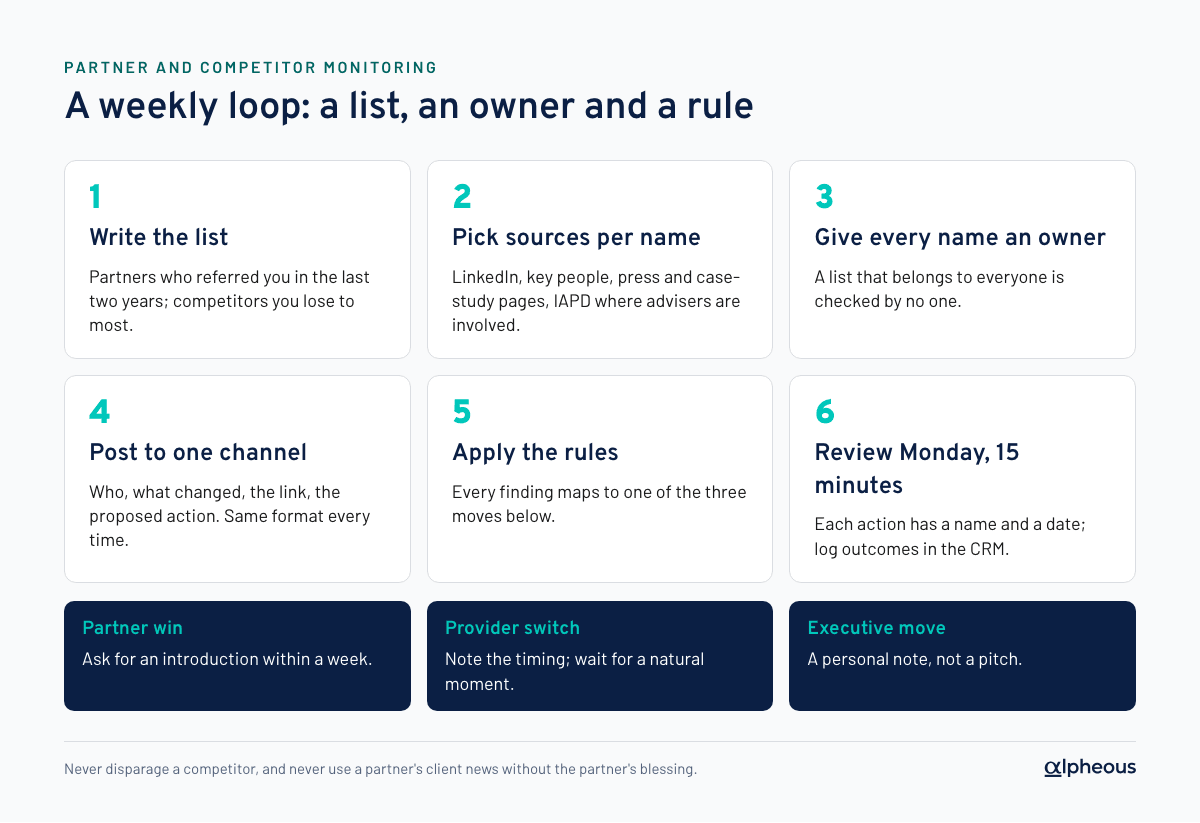
- Write the list. The partners who referred you something in the last two years, and the competitors you lose to most.
- Pick sources per name. The LinkedIn page, two or three key people, the press page, case studies and services pages, and IAPD where advisers are involved.
- Give every name an owner. A list that belongs to everyone is checked by no one.
- Post findings to one shared channel. Same format every time: who, what changed, the link, the proposed action.
- Apply the rules. A partner win means asking for an intro within a week. A provider switch means noting the timing, then waiting for a natural moment (a fund launch, a review cycle). An executive move means a personal note, not a pitch.
- Review for 15 minutes on Monday. Confirm each action has a name and a date, and log outcomes in the CRM against the partner.
Generic competitor monitoring tools can feed steps 2 and 4, but few know what Schedule D is. For the inside-out view, HubSpot buyer intent in financial services covers what your own website data can and cannot see.
What are the rules of etiquette?
This market is small, and the person at a competitor today is your partner or hire in three years.
- Never disparage a competitor. Not in an email, not on a call. Sell on your own merits and the client's timing.
- Never use a partner's client news without the partner's blessing. Write to the partner ("congratulations; would an intro help, or is it too early?"), not cold to their new client.
- Help first. Send partners referrals before you ask for them.
- Treat a provider switch as context, not an opening. A fund that just changed administrator is not shopping again yet.
How does partner monitoring become account mapping?
Account mapping is comparing your account list with a partner's to find shared clients and each other's prospects. Most account mapping conversations start cold: two spreadsheets and no reason to act.
A quarter of logged partner wins fixes that. Bring the list to your next partner meeting: five clients you added that we could serve, three of ours that need you, and the intro we can make this month. B2B referral partners respond to specifics and reciprocity. Track each intro as partner-sourced, and next quarter you can see which partners actually send business.
Where Alpheous fits
Alpheous is AI infrastructure for financial services distribution, installed on-premise at your firm. Overnight it scans press, LinkedIn changes, website changes and Form ADV changes (assets, disclosures, custody, office moves, amendments), so the morning brief shows what moved. Asset managers watching peers get 13F holdings to compare quarter to quarter. Dedicated partner and competitor watch alerts are the kind of signal we're building toward.
Take the tour to see the overnight signals, or book a call to talk through your partner list.
FAQ
What is competitor monitoring for sales?
Competitor monitoring for sales is the routine of tracking what competitors and referral partners announce, post, hire and file, then acting on each change by an agreed rule. For firms selling to advisers and fund managers, the useful signals are client wins, executive moves, website changes and Form ADV provider changes.
How can I find out which administrator a private fund uses?
Look at the adviser's Form ADV Part 1A, Schedule D, Section 7.B.(1), on the SEC's IAPD site. Question 26 asks whether each private fund uses an administrator other than the adviser and, if so, names it; questions 23 to 25 cover the auditor, prime broker and custodian. This data refreshes with the annual amendment, so it can be up to about a year old.
How do I ask a referral partner for an introduction after they win a client?
Write to the partner, not the client: congratulate them and ask whether an introduction would help now or later. Never contact their new client with their news unless the partner agrees.
Do referral partners improve win rates?
Crossbeam, which sells partner-ecosystem software, reports an 11.7% average lift in win rate when partners are involved in deals, based on its own network data. A 2011 Journal of Marketing study of a German bank found referred customers were worth at least 16% more than similar non-referred customers. Neither is specific to B2B financial services, but both point the same way.
How often should a sales team review partner and competitor signals?
Weekly is enough for most firms selling to advisers and fund managers. Partner wins need a response within about a week to be useful, while Form ADV provider changes update only once a year per firm.