How to archive AI-drafted sales emails for SEC and FINRA
Archive AI-drafted sales emails by having a person send them from a firm mailbox your archive already captures, and keep the draft and approval trail.

- What do SEC and FINRA require you to keep for sales emails?
- What does FINRA Rule 3110 require for reviewing correspondence?
- What counts as the record when AI drafts an email?
- What is the simplest archiving design for AI-drafted email?
- Why does an AI tool that sends on its own create an archiving gap?
- How does off-channel communication risk apply to AI tools?
- How do you keep the approval chain exportable for an exam?
- An archiving checklist for AI-drafted sales email
- How Alpheous fits this design
- FAQ
- Sources
In this article
- What do SEC and FINRA require you to keep for sales emails?
- What does FINRA Rule 3110 require for reviewing correspondence?
- What counts as the record when AI drafts an email?
- What is the simplest archiving design for AI-drafted email?
- Why does an AI tool that sends on its own create an archiving gap?
- How does off-channel communication risk apply to AI tools?
- How do you keep the approval chain exportable for an exam?
- An archiving checklist for AI-drafted sales email
- How Alpheous fits this design
- FAQ
- Sources
The simplest way to archive AI-drafted sales emails is to never let the AI tool send them. Have the AI put a draft in the rep's own firm mailbox, have a person review and send it from there, and the email flows through the same journaling into Smarsh, Global Relay or whatever archive already captures your business email. What the archive will not hold is the history behind the email: the draft, who approved it and when. Keep that trail too, in a form you can export for an exam.
What do SEC and FINRA require you to keep for sales emails?
For broker-dealers, SEC Rule 17a-4(b)(4) requires "originals of all communications received and copies of all communications sent (and any approvals thereof)" relating to the firm's business as such. Those records must be kept for not less than three years, the first two in an easily accessible place. FINRA Rule 4511 adds that FINRA-required records must be preserved in a format and media that complies with Rule 17a-4, and for at least six years where no other period is specified.
For investment advisers, SEC Rule 204-2 requires copies of written communications relating to, among other things, recommendations or advice, and paragraph (a)(11) requires a copy of each advertisement the adviser disseminates. Those records are kept for not less than five years, the first two in an appropriate office of the adviser. Whether a particular one-to-one prospecting email falls inside 204-2 depends on what it says, which is why many advisers simply capture all business email rather than sorting it.
Neither rule cares who or what wrote the email. FINRA has said its rules are technology neutral and apply to generative AI (Regulatory Notice 24-09). An AI-drafted email that goes to a prospect is a business communication like any other.
This is not legal or compliance advice; confirm your firm's obligations with your CCO.
What does FINRA Rule 3110 require for reviewing correspondence?
Under FINRA Rule 2210(a)(2), "correspondence" is a written (including electronic) communication distributed or made available to 25 or fewer retail investors within any 30 calendar-day period. Rule 2210(b)(2) says all correspondence is subject to the supervision and review requirements of Rules 3110(b) and 3110.06 through .09. A prospecting email sent only to institutional investors can be an institutional communication instead, with its own review procedures under 2210(b)(3); FINRA 2210 and emails to financial advisors covers how to tell which you are sending.
Rule 3110(b)(4) requires procedures for reviewing incoming and outgoing written (including electronic) correspondence, and says reviews "must be conducted by a registered principal and must be evidenced in writing." Supplementary Material .07 spells out the evidence: it must "clearly identify the reviewer, the internal communication or correspondence that was reviewed, the date of review, and the actions taken." It adds: "Merely opening a communication is not sufficient review."
Supplementary Material .06 lets a firm use risk-based review rather than pre-approving every email, as long as it provides training, documents the training, and runs surveillance and follow-up. Either way, review evidence is a record you need to be able to produce.
What counts as the record when AI drafts an email?
The sent email is the core record, and that is what your archive already captures. Around it sit three things the archive usually does not see:
| Item | Is it clearly required? | Why keep it anyway |
|---|---|---|
| The email as sent | Yes: 17a-4(b)(4) for broker-dealers; 204-2 where the content falls in scope | It is the communication itself |
| Approval of the email | 17a-4(b)(4) names "any approvals thereof"; 3110.07 requires evidence of review | Proves supervision happened, and by whom |
| The AI draft before edits | Not named in the rules | Shows what the person changed; answers "did AI write this claim?" |
| Sources and prompt behind the draft | Not named in the rules | Lets you trace a stated fact back to where it came from |
How far to go on the last two rows is a policy decision for your CCO. The first two are not optional, and the second is where AI workflows most often fall short: a rep pasting a ChatGPT draft into Outlook leaves the sent email in the archive and no trace of who, if anyone, approved it.
What is the simplest archiving design for AI-drafted email?
Keep sending where it already is. Most firms already journal business email from Microsoft 365 or Google Workspace into an archive such as Smarsh or Global Relay, and that pipeline is already in their written procedures.
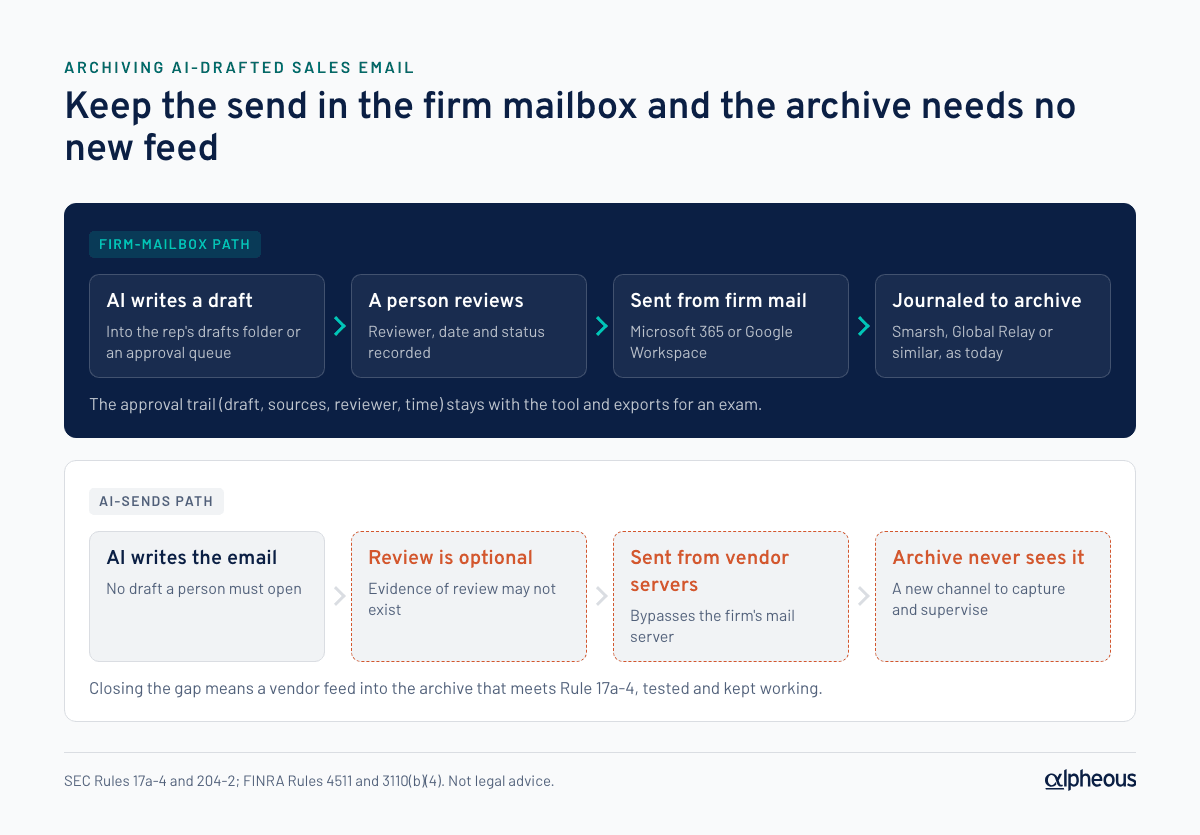
The design has four rules:
- The AI tool writes drafts, never sends. Its output lands in the rep's drafts folder or an approval queue.
- A person sends from the firm mailbox. The email leaves through the same server as every other business email.
- The existing journal captures it. No new connector, no new archive feed, no change to your archive contract.
- The approval trail lives alongside. The tool records the draft, its review status, who approved it and when, and can export that record.
Under this design, the archive integration question disappears. You do not need the AI vendor to connect to Smarsh; you need it to stay out of the send path.
Why does an AI tool that sends on its own create an archiving gap?
Many AI sales tools send email from their own infrastructure: a sending domain, a shared mail service or an API connection that delivers outside your mail server. Those messages never pass your journal. They exist in the vendor's database, if anywhere, in whatever format and retention the vendor chose.
To close that gap you would need the vendor to deliver every sent message, with metadata, to your archive in a 17a-4 compliant way, and to prove it keeps doing so. Rule 17a-4(f) sets real requirements for electronic recordkeeping systems: either a complete time-stamped audit trail of modifications and deletions, or storage "exclusively in a non-rewriteable, non-erasable format," plus automatic verification of the storage process. That is a serious due-diligence project for each tool, and it breaks the day the vendor changes its sending setup.
It also removes the person from the send, which makes 3110 review evidence harder to produce. For why the send step is the control point, see the AI agent security checklist.
How does off-channel communication risk apply to AI tools?
"Off-channel" means business communication on a channel the firm does not capture: personal texts, WhatsApp, personal email. In September 2022 the SEC charged 15 broker-dealers and one affiliated investment adviser for failing to maintain and preserve electronic communications, with combined penalties of more than $1.1 billion.
An AI tool that sends from its own servers is, functionally, a new channel. If nobody added it to the firm's capture and supervision procedures, its messages sit outside the archive in the same way a personal text does. Two other patterns create the same risk:
- Reps using personal AI accounts to draft and then sending from a personal address "just this once."
- AI tools that reply to inbound mail automatically, outside the firm's mail server.
The fix is the same in each case: route the final send through the captured firm mailbox, and write the AI tool into your communications policy.
How do you keep the approval chain exportable for an exam?
An examiner who asks about an AI-assisted email may want to see more than the message. Plan for a request like "show us how this email was produced and who reviewed it." A workable record per email:
- Draft ID and timestamp when the AI produced the draft.
- Sources the draft was grounded in (CRM record, filing, approved fact sheet).
- Review status, the reviewer's identity and the review date.
- Changes between draft and sent version, or at least the final draft.
- Send event: who sent it and from which mailbox, so it can be matched to the archived copy.
Check that your tool exports this as a file, not a screenshot of a dashboard, and ask what happens to vendor-held records when the contract ends. Test it before a pilot goes live (AI outreach pilot design).
An archiving checklist for AI-drafted sales email
- Confirm with compliance which communications your firm treats as required records under 17a-4 or 204-2.
- Turn off auto-send in every AI tool reps use; output becomes a draft.
- Send only from firm mailboxes that your archive already journals.
- Ban personal AI accounts for business drafting, or bring them under policy.
- Record review evidence that names the reviewer, the email, the date and any action (3110.07).
- Keep the draft and sources for as long as your policy says, alongside the sent email.
- Test an export of one email's full trail before you scale.
- Write the AI tool into your WSPs and communications policy, including how it is supervised.
- Ask every vendor whether it can ever send on its own, and get the answer in writing.
If you also want AI drafts to stay inside approved language, see using AI to personalize an approved email template.
How Alpheous fits this design
Alpheous was built around the firm-mailbox path:
- It never sends on its own. Generated outbound ends in a person's mailbox drafts or an approval queue. The block sits at the send choke point, fails closed and is off by default; turning on automatic sending would be an explicit, recorded grant, not a code change.
- Mail runs on the firm's own account. Drafts go into the person's own firm mailbox, so a sent email is captured by whatever journaling the firm already has.
- An audit chain on every action. Actions touching communications record who, what and when; drafts carry a review status; records stay on the firm's appliance and can be exported.
- On hardware the firm owns. Alpheous runs as a single-tenant appliance in the firm's own office (see on-premises AI vs cloud).
Policies, including the regulatory mapping, are in the trust center. Take the tour or book a call.
FAQ
Do AI-drafted emails need to be archived?
Yes, if the email would be a required record had a person written it. SEC Rules 17a-4 and 204-2 do not distinguish by author, and FINRA says its rules are technology neutral and apply to generative AI.
Do I need to archive the AI draft as well as the sent email?
The rules clearly cover the communication sent and, for broker-dealers, "any approvals thereof." The pre-edit draft is not named, but many firms keep it so they can show what a person changed. Decide with your CCO and write it into policy.
Does my AI sales tool need to integrate with Smarsh or Global Relay?
Not if a person sends every email from a firm mailbox your archive already captures. An integration only becomes necessary when the tool sends from its own infrastructure, which is the design to avoid.
How long must broker-dealers keep sales emails?
Under SEC Rule 17a-4(b), communications covered by paragraph (b)(4) are kept for not less than three years, the first two in an easily accessible place. Investment advisers keep Rule 204-2 records for not less than five years, the first two in an appropriate office.
What evidence of review does FINRA Rule 3110 require?
Supplementary Material .07 says evidence of review must identify the reviewer, the correspondence reviewed, the date of review and the actions taken on any significant regulatory issues. Merely opening a communication is not sufficient review.
Is an AI tool that sends email an off-channel communication risk?
It can be. If the tool sends from its own servers and the firm has not brought that channel under capture and supervision, its messages sit outside the archive, the same failure behind the SEC's 2022 off-channel recordkeeping cases.
Sources
- SEC Rule 17a-4(b)(4) (ecfr.gov)
- FINRA Rule 4511 (finra.org)
- SEC Rule 204-2 (ecfr.gov)
- Regulatory Notice 24-09 (finra.org)
- FINRA Rule 2210(a)(2) (finra.org)
- Rule 3110(b)(4) (finra.org)
- charged 15 broker-dealers and one affiliated investment adviser (sec.gov)

Dave founded Alpheous in 2026 after years of building technology platforms and seeing the same operational bottlenecks across asset management distribution teams.
Dave Ward on LinkedInMore in AI prospecting

On-premises AI vs cloud: where should an asset manager run AI?
On-premises AI vs cloud for asset managers: weigh control, records, backup, security, cost and upkeep, what to ask about any box, and when your own cloud wins.
Can AI personalize a compliance-approved email template?
Yes, if the principal approves the template and the rules for each AI-filled field, and the fills cannot change what the email claims. Here is how to design it.

AI token costs for prospecting: model routing and your own keys
AI token costs for sales prospecting, explained: October 2026 list prices, a worked cost per prospect, model routing math, and six questions to ask vendors.
Alpheous reads the filings every night and ranks who to call next.