Can AI personalize a compliance-approved email template?
Yes, if the principal approves the template and the rules for each AI-filled field, and the fills cannot change what the email claims. Here is how to design it.
- How does FINRA Rule 2210 classify an email?
- When does a retail email need pre-use principal approval?
- Does AI personalization make it a new communication?
- How do you design a locked template with an AI personal-touch layer?
- What checks should run on the AI-filled fields?
- Why show the reviewer a diff against the approved template?
- How do you count recipients of similar emails over 30 days?
- A checklist for AI-personalized templates
- How Alpheous fits a template workflow
- FAQ
- Sources
In this article
- How does FINRA Rule 2210 classify an email?
- When does a retail email need pre-use principal approval?
- Does AI personalization make it a new communication?
- How do you design a locked template with an AI personal-touch layer?
- What checks should run on the AI-filled fields?
- Why show the reviewer a diff against the approved template?
- How do you count recipients of similar emails over 30 days?
- A checklist for AI-personalized templates
- How Alpheous fits a template workflow
- FAQ
- Sources
AI can personalize a compliance-approved email template without a fresh approval for every send, but only if the personalization cannot change what the email says about your firm, its products or performance. The practical design is a locked template that carries every material claim, plus a small set of named fields the AI may fill, each with written rules your principal approved along with the template. If the AI can rewrite the body, each version is arguably a new communication, and FINRA Rule 2210 has no exception for "the AI wrote it."
This is not legal or compliance advice; confirm your approach with your CCO and principal.
How does FINRA Rule 2210 classify an email?
FINRA Rule 2210 sorts every written communication into one of three categories in paragraph (a):
| Category | Definition in Rule 2210(a) | Pre-use principal approval? |
|---|---|---|
| Correspondence | Distributed or made available to 25 or fewer retail investors within any 30 calendar-day period | No; supervised and reviewed under Rule 3110(b) and 3110.06 to .09 |
| Retail communication | Distributed or made available to more than 25 retail investors within any 30 calendar-day period | Yes, before the earlier of use or filing, with some exceptions |
| Institutional communication | Distributed or made available only to institutional investors | No by default; written review procedures required |
A "retail investor" is anyone who is not an institutional investor, and the institutional definition is broader than most people expect: it includes registered investment advisers and registered persons of FINRA members. So a wholesaler emailing advisors may be sending institutional communications, not retail ones. We cover that question in detail in Are emails to financial advisors retail or institutional communications? For the rest of this post, assume the template goes to recipients your compliance team treats as retail investors, because that is where the template question bites.
When does a retail email need pre-use principal approval?
Rule 2210(b)(1)(A) says an appropriately qualified registered principal "must approve each retail communication before the earlier of its use or filing" with FINRA's Advertising Regulation Department. There are exceptions. One that matters for outreach is 2210(b)(1)(D)(iii): a retail communication that "does not make any financial or investment recommendation or otherwise promote a product or service of the member" does not need pre-use approval, though it must still be supervised like correspondence. A distribution email that names a fund or a strategy almost always promotes a product, so do not plan around that exception.
The content standards in Rule 2210(d) apply to all three categories. Every communication must be fair and balanced, may not be "false, exaggerated, unwarranted, promissory or misleading," and under 2210(d)(1)(F) may not "predict or project performance, imply that past performance will recur or make any exaggerated or unwarranted claim, opinion or forecast." Approval is a process requirement. The content standards apply whether or not anyone approved the email.
Does AI personalization make it a new communication?
FINRA is clear that the author does not matter. Its Rule 2210 FAQ D.8 says firms "are responsible for their communications, regardless of whether they are generated by a human or AI technology," including supervision, recordkeeping and the content standards. Regulatory Notice 24-09 makes the same point about FINRA's rules generally.
What the rule does not do is define when a personalized version of an approved template stops being the approved communication. The closest analogy in the rule text is on the filing side, not approval: 2210(c)(7)(A) excludes from filing retail communications previously filed and "used without material change," and 2210(c)(7)(B) excludes communications based on previously filed templates where changes are limited to "updates of more recent statistical or other non-narrative information" and certain non-predictive narrative. That tells you how FINRA thinks about templates: fixed narrative, narrowly bounded variables.
In practice, compliance teams tend to ask two things about a personalized version:
- Did any claim change? Anything about the firm, a product, performance, risk, fees or outcomes is a claim. If the AI can add, drop or reword one, the version is substantively different.
- Is the variable part bounded and checkable? A name and a meeting time are bounded. "A sentence about why this is relevant to them" is not bounded unless you write rules for it.
If both answers are comfortable, many principals will treat each send as a use of the approved template. If either is shaky, treat AI output as a new draft that needs its own review. Your principal makes this call, not the vendor and not the model.
How do you design a locked template with an AI personal-touch layer?
Split the email into two layers with different owners.
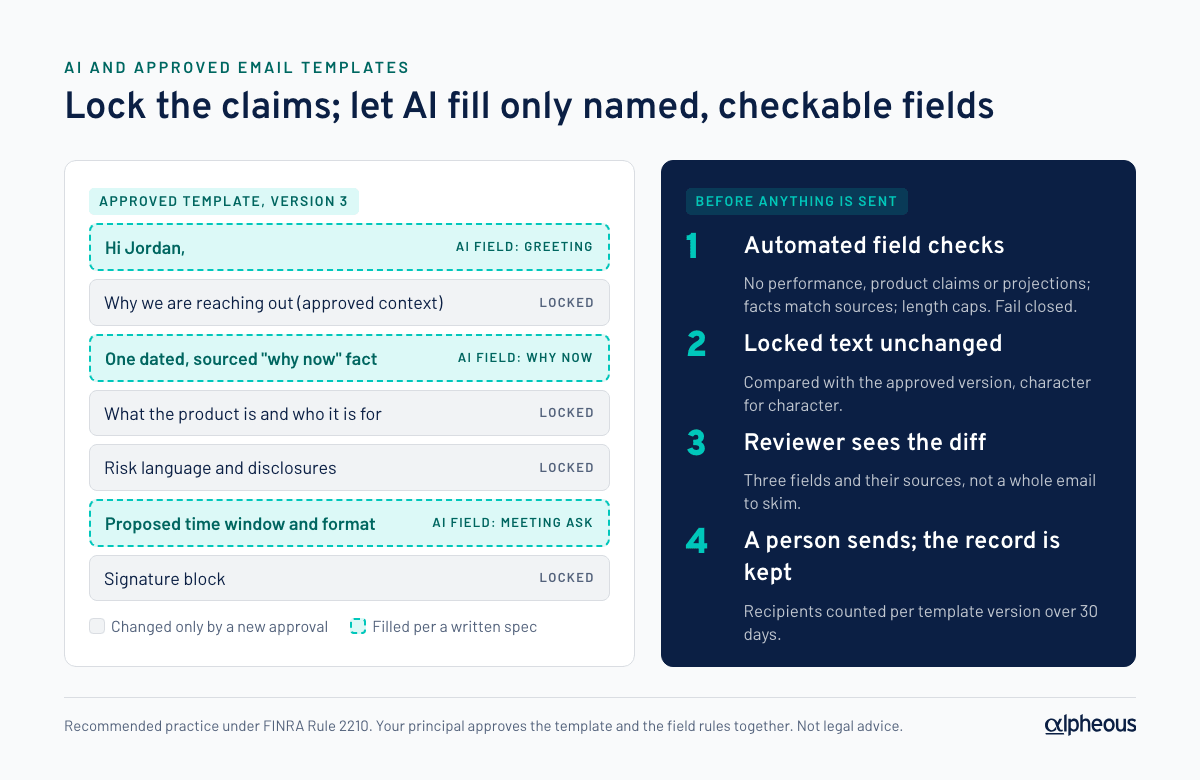
The locked layer is the approved text. It holds every material statement: what the product is, who it is for, any risk language, disclosures and the signature block. Nobody edits it at send time, human or model. A change means a new version, approved again.
The personal-touch layer is a short list of named fields, each with a written spec the principal approves alongside the template:
| Field | What the AI may write | What it may never write |
|---|---|---|
| Greeting | Recipient's name and title, from the CRM record | Anything else |
| Why now (one sentence) | A dated, public, checkable fact about the recipient's firm, with its source recorded (for example a filing date or a new office) | Product benefits, performance, opinions about the recipient's results |
| Meeting ask | A proposed time window and format | Urgency claims, promises of what the meeting will deliver |
Three design rules keep this honest:
- Material claims only in the locked layer. If a sales leader wants a new claim, it goes into the template and through approval, not into a field.
- Fields are short and typed. Set a length cap per field. A 400-character "why now" is a paragraph, and a paragraph can say anything.
- Every fact in a field has a source. The why-now sentence must cite where its fact came from, so a reviewer can check it in seconds. The same grounding rule appears in our guide to AI guardrails for BDR outreach; here it is applied field by field.
What checks should run on the AI-filled fields?
Run them automatically on every draft, before a person sees it, and fail closed: if a check cannot run, the draft does not move forward.
- No performance language. Block returns, percentages tied to a fund, "outperform," "beat," "track record" and similar.
- No product claims. Block product names and benefit words in personal fields; products live in the locked layer.
- No projections or promises. Block forward-looking verbs tied to outcomes ("will deliver," "expect to grow," "guaranteed"), mirroring 2210(d)(1)(F).
- Fact check against the source. The why-now sentence must match its recorded source; a date or number that is not in the source fails.
- Length and character limits per field, and no links in personal fields unless the link is on an approved list.
- Locked layer integrity. Compare the locked text byte for byte with the approved version. Any difference fails.
Treat inbound text (a prospect's website, an email reply) as untrusted input. A web page can contain instructions aimed at a model, so sanitize it before it reaches the model that fills the fields.
Why show the reviewer a diff against the approved template?
Because a reviewer reading a whole fluent email will skim. A diff shows only what changed from the approved version: here are the three fields, here is what the AI put in each, here is the source behind the why-now sentence, and here is the confirmation that the locked text is unchanged. A five-second review of three highlighted fields is something a rep or supervisor will actually do on every send. A full read of every email is not.
Keep the diff with the record. Rule 2210(b)(4) and Rule 4511 require you to keep communications, and SEC Rule 17a-4(b)(4) requires broker-dealers to preserve copies of communications sent "(and any approvals thereof)" for at least three years, the first two in an easily accessible place (17 CFR 240.17a-4). For how that works when AI drafted the email, see archiving AI-drafted emails.
How do you count recipients of similar emails over 30 days?
The 25-retail-investor line is cumulative over "any 30 calendar-day period," so a template sent to 15 people on Monday and 15 more two weeks later has reached 30. Count per template version, on a rolling window, across every rep who uses it:
- Give each approved template a version ID and stamp it on every draft built from it.
- Count distinct retail recipients per version over a rolling 30 days, across the whole team.
- Warn before the line, not after. Alert at, say, 20, and block sends that would cross 25 unless the version has retail-communication approval.
- Do not reset the count with a cosmetic edit. If the claims are the same, a reworded subject line should not start a new count. Ask your CCO how your firm groups versions.
This counter is recommended practice, not something most email tools do out of the box. If you are scoping it into a trial, put it in the compliance gate of your AI outreach pilot design.
A checklist for AI-personalized templates
- Classify the audience first: retail, institutional or mixed.
- Write the template with every material claim in locked text.
- Name the AI fields, with a written spec and length cap for each.
- Get the principal to approve the template and the field specs together.
- Run automated checks on every filled field; fail closed.
- Show the reviewer a diff, not a whole email.
- Count recipients per template version over a rolling 30 days.
- Keep the draft, the sources, the diff, the check results and who sent it.
- Spot-check a sample of sent emails each week against the approved version.
If you are choosing where the model runs, the data question matters too: see on-premises AI vs cloud and the AI agent security checklist.
How Alpheous fits a template workflow
Alpheous is built so that a person stays between the model and the inbox. It never sends on its own: generated outreach lands in the rep's own mailbox drafts or an approval queue, enforced at the send step, fail-closed and off by default. Each draft carries a review status, and every action touching communications records who, what and when, on an appliance the firm owns, with records the firm can export. Inbound email and web content are sanitized before they reach a model, and every model call is logged with model, tokens and latency. Each ranked advisor or firm comes with the reasons it ranked, which gives reps a sourced starting point for a why-now line.
Locked-template slot filling and a 30-day recipient counter are practices we recommend, not features we claim. Take the tour or book a call.
FAQ
Does an AI-personalized email need principal approval under FINRA Rule 2210?
It depends on the audience. A retail communication (more than 25 retail investors within any 30 calendar-day period) needs pre-use principal approval unless an exception applies; correspondence and institutional communications do not, but must be supervised. Whether an AI-personalized version counts as the approved template is a judgment for your principal.
Is a firm responsible for emails written by AI?
Yes. FINRA's Rule 2210 FAQ says firms are responsible for their communications whether a human or AI generated them, including supervision, recordkeeping and content standards.
What can AI safely personalize in an approved template?
Keep it to bounded, low-risk fields: the greeting, one dated and sourced "why now" sentence, and the meeting ask. Anything about products, performance, risk or outcomes belongs in the locked, approved text.
Do the 25 retail investors count per email or per template?
Rule 2210 counts a communication distributed or made available to retail investors within any 30 calendar-day period, so recipients add up across sends and across reps. Count per approved template version on a rolling window, and ask your CCO how your firm groups versions.
Does FINRA have a template rule?
Rule 2210(c)(7)(B) excludes certain template-based retail communications from filing when changes are limited to updated statistical or non-narrative information and certain non-predictive narrative. That is a filing exclusion, not an approval exception, but it shows the pattern: fixed narrative, narrowly bounded variables.
Sources
- FINRA Rule 2210 (finra.org)
- Rule 2210 FAQ D.8 (finra.org)
- Regulatory Notice 24-09 (finra.org)
- 17 CFR 240.17a-4 (ecfr.gov)

Dave founded Alpheous in 2026 after years of building technology platforms and seeing the same operational bottlenecks across asset management distribution teams.
Dave Ward on LinkedInMore in AI prospecting

On-premises AI vs cloud: where should an asset manager run AI?
On-premises AI vs cloud for asset managers: weigh control, records, backup, security, cost and upkeep, what to ask about any box, and when your own cloud wins.

How to archive AI-drafted sales emails for SEC and FINRA
Archive AI-drafted sales emails by having a person send them from a firm mailbox your archive already captures, and keep the draft and approval trail.

AI token costs for prospecting: model routing and your own keys
AI token costs for sales prospecting, explained: October 2026 list prices, a worked cost per prospect, model routing math, and six questions to ask vendors.
Alpheous reads the filings every night and ranks who to call next.