AI outreach pilot design for asset management distribution
Run an AI outreach pilot without booking meetings nobody can take: gates before the first send, a weekly meeting cap, a locked holdout and a 90-day decision.
- Why do AI outreach pilots book meetings nobody can take?
- What has to be true before the first AI email is sent?
- How do you set capacity before you set volume?
- Why does an AI outreach pilot need a holdout group?
- Who owns each advisor during the pilot?
- What should an AI outreach pilot measure?
- How much autonomy should the AI get, and when?
- How do you run the weekly review and the kill switch?
- What does the go, adjust or stop decision look like at 90 days?
- How Alpheous supports an outreach pilot
- FAQ
- Sources
In this article
- Why do AI outreach pilots book meetings nobody can take?
- What has to be true before the first AI email is sent?
- How do you set capacity before you set volume?
- Why does an AI outreach pilot need a holdout group?
- Who owns each advisor during the pilot?
- What should an AI outreach pilot measure?
- How much autonomy should the AI get, and when?
- How do you run the weekly review and the kill switch?
- What does the go, adjust or stop decision look like at 90 days?
- How Alpheous supports an outreach pilot
- FAQ
- Sources
To run an AI outreach pilot in asset management distribution without booking meetings nobody can take, start from capacity, not volume. Agree a weekly meeting cap with the specialists who will take the meetings, name the person who answers every reply, and ramp sending only up to that cap. Close five gates before the first send (data rights, compliance, security, capacity and a written test plan), lock a randomized holdout at launch, and decide go, adjust or stop at about 90 days against criteria you wrote down on day one.
Why do AI outreach pilots book meetings nobody can take?
Because they are designed by the people who send, not the people who answer. A team points an AI tool at a list of advisors and measures replies. The tool works: meetings land on the calendars of product specialists who were never asked, and interested advisors wait days for an answer. An advisor who replies and hears nothing is worse off than one you never emailed.
The second pattern is collision: the internal desk, a calling partner and the AI sequence reach the same advisor in the same fortnight, each from its own list. Both failures are design problems, and a plan that starts from capacity and ownership prevents them.
What has to be true before the first AI email is sent?
Five gates, all closed before launch, each with a named owner and a written yes.
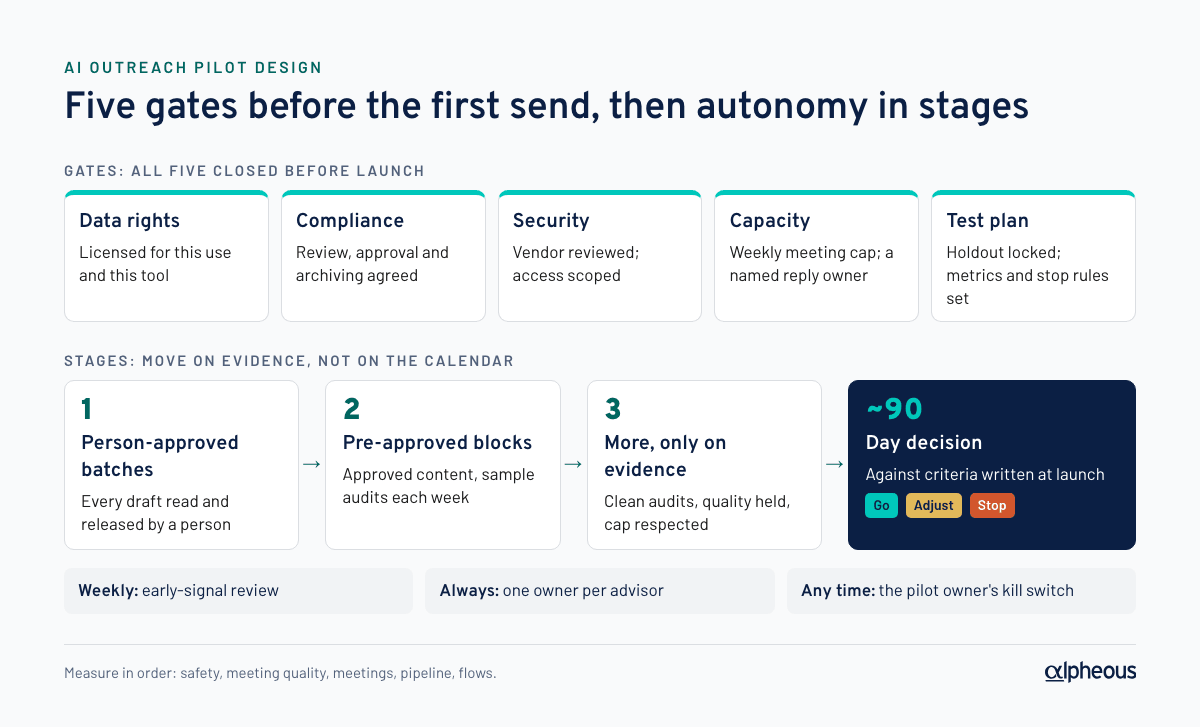
- Data rights. Confirm that the advisor and firm data you plan to use is licensed for this use, in this tool. Data licenses can restrict loading records into third-party software or AI models. See licensed data and AI tools.
- Compliance. Agree with your CCO how drafts are reviewed and approved, which claims and phrases are allowed, and how sent messages are archived. FINRA's rules are "intended to be technology neutral" (Regulatory Notice 24-09). Start with FINRA 2210 and emails to financial advisors and archiving AI-drafted emails.
- Security. Your security lead reviews the vendor, where data is processed and what the model provider retains. The AI agent security checklist and on-premises AI vs cloud cover the questions.
- Capacity. A weekly meeting cap agreed with the specialists, a named person who answers replies, and a named backup. More on this below.
- Test plan. Written, with the holdout, the metrics, the stop rules and the decision date, and reviewed by someone outside the pilot team.
If one gate is open, the pilot waits: you cannot unsend.
How do you set capacity before you set volume?
Work backwards from the people who take the meetings.
- Agree a weekly meeting cap with the specialists. Ask the specialists or senior wholesalers how many new advisor meetings they can take per week without dropping existing work. That number is the ceiling, not a target.
- Ramp sending to the cap. Start with small weekly batches and raise volume only while meetings stay under the cap. If a week overshoots, the next batch shrinks.
- Name a reply owner. One named person answers every reply within one business day, including the "not now" and "wrong person" replies. Name a backup for holidays and sick days, and write the handoff down.
- Route by what was asked. Product questions go to the specialist; removal requests go to the suppression list the same day.
Why does an AI outreach pilot need a holdout group?
Because "meetings went up" is not evidence the pilot worked: markets move, funds launch, a wholesaler has a strong quarter. A holdout, or control group, is a randomly chosen slice of the eligible advisor list that the pilot does not contact. Practical rules:
- Randomize, do not hand-pick. Draw it from the same eligible list; a hand-picked control is a biased one.
- Lock it at launch. Record membership before the first send and never move advisors in or out mid-pilot.
- Keep business as usual for both groups. The only difference is the AI outreach.
- Size it deliberately. It must be large enough to show a difference at the meeting rates you expect; ask your independent reviewer.
At the decision point, compare meetings and pipeline per advisor in the pilot group against the holdout. The gap is the added reach.
Who owns each advisor during the pilot?
One owner per advisor, written into the CRM before launch, so the desk, a calling partner and the specialists never double-touch. Advisors already in conversation with any of them are excluded from the pilot list, recent activity is checked before each batch, and an advisor who books through the pilot goes to one named person. The rules of engagement in how to stop multiple sales reps contacting the same account apply unchanged; the pilot is one more rep.
What should an AI outreach pilot measure?
Measure in order, and do not read a later line until the earlier ones are healthy.
| Order | Measure | How to read it | Who judges it | Stop or adjust signal |
|---|---|---|---|---|
| 1 | Safety | Compliance exceptions, factual errors found in audits, unsubscribe and complaint replies, wrong-person sends | Compliance and the pilot owner | Any compliance breach; a rising error rate in sample audits |
| 2 | Meeting quality | Specialists rate each meeting (for example, worth having or not) against a fit definition agreed at launch | The specialists who took the meetings | A sustained run of meetings rated not worth having |
| 3 | Meetings | Meetings held per advisor, pilot vs holdout; meetings against the weekly cap | Pilot owner | Cap exceeded; no gap over the holdout |
| 4 | Pipeline | Opportunities created and progressed from pilot meetings, pilot vs holdout | Sales leadership | Meetings that never turn into next steps |
| 5 | Flows | Assets or allocations traced to pilot advisors, read cautiously | Distribution leadership | Too early to call inside 90 days for most products |
| Ops | Reply handling | Share of replies answered within one business day | Reply owner and backup | Replies waiting past the window |
Meeting quality is rated by the people who sat in the meeting, not the team that sent the email. Flows lag, so set expectations about them in the test plan rather than at the review.
How much autonomy should the AI get, and when?
Earn it in stages, and move between stages on evidence rather than on the calendar.
- Stage 1: person-approved batches. A named person reads and releases every draft. Slow, and it shows you where drafts go wrong.
- Stage 2: pre-approved content blocks. Compliance approves a set of content blocks (introductions, product descriptions, calls to action), and drafts are assembled from them (see personalizing an approved email template with AI). A person still releases each batch, and someone audits a sample of sent emails every week, tracing each fact back to its source.
- Stage 3: more autonomy, only on evidence. Consider widening only after several clean weeks of audits, stable meeting quality and a respected cap. Any widening is a recorded decision by the pilot owner and compliance, not a setting someone flips.
Whatever the stage, AI-drafted messages remain your firm's communications. Under FINRA Rule 2210, a written communication distributed to "25 or fewer retail investors within any 30 calendar-day period" is correspondence, and "all correspondence is subject to the supervision and review requirements of Rules 3110(b)"; one sent to more than 25 retail investors in that window is a retail communication, which an appropriately qualified registered principal must approve before use (Rule 2210(b)(1)(A)). Which category your advisor outreach falls into is a question for your compliance team. This is not legal or compliance advice; confirm with your CCO.
How do you run the weekly review and the kill switch?
A weekly early-signal review, thirty minutes, same agenda: audit findings, meeting ratings, meetings against the cap, reply times and collisions. The decision is written down: batch size up, down or unchanged.
A kill switch the pilot owner can pull. One named person can pause all pilot sending on their own authority, without a meeting. Write down in advance what pulls it: a compliance breach, a data-rights question, a reply backlog, or a full calendar. Restarting requires the weekly review.
An independent reviewer for the test plan. Before launch, someone outside the pilot team (an analyst, finance or internal audit) checks the holdout, the metrics and the decision criteria. People who want the pilot to succeed are poor judges of whether it did.
What does the go, adjust or stop decision look like at 90 days?
Write the criteria at launch, then read them back at about 90 days.
- Go: safety clean, specialists rate most meetings worth having, pilot advisors show more meetings and pipeline than the holdout, and the cap and reply window held. Expand carefully, with the same gates.
- Adjust: safety clean but the gap over the holdout is small, or meeting quality is mixed. Change one variable (the list, the content blocks or the fit definition) and run another cycle.
- Stop: a safety problem that repeated, meeting quality the specialists reject, or no gap over the holdout. Stopping is a valid result; it saves the next year's budget.
How Alpheous supports an outreach pilot
Alpheous is built for the release-controlled stages of a pilot. It never sends on its own: AI-drafted outreach lands in a person's mailbox drafts or an approval queue, enforced at the send choke point and off by default, so enabling automatic sending would be an explicit, recorded decision rather than a code change. Every action touching communications records who did what and when, drafts carry a review status, and the records stay on the firm's own appliance and can be exported for the pilot review.
Every ranked advisor or firm shows the reasons it ranked, and scores and reasons write into HubSpot, so specialists can see why each advisor was chosen. It runs as a single-tenant appliance on hardware the firm owns. Meeting caps, the holdout and the kill switch are practices you run in your own process. See security and compliance or take the tour.
FAQ
How long should an AI outreach pilot run in asset management distribution?
About 90 days is a common window: long enough to see meetings and early pipeline, short enough to stop cleanly. Asset flows usually take longer to show, so set expectations about them in the test plan.
What is a holdout group in an outreach pilot?
A holdout group is a randomly chosen part of the eligible advisor list that the pilot does not contact, locked at launch. Comparing pilot advisors with the holdout shows how much reach the pilot added beyond business as usual.
How do you avoid booking more meetings than specialists can take?
Agree a weekly meeting cap with the specialists before launch and ramp sending only up to it. Shrink the next batch when a week overshoots, and name one person, plus a backup, to answer every reply within one business day.
Should AI send outreach emails automatically during a pilot?
Not at the start. Begin with person-approved batches, move to pre-approved content blocks with weekly sample audits, and widen autonomy only on evidence and as a recorded decision with compliance.
Does FINRA Rule 2210 apply to AI-drafted outreach?
Yes. FINRA Regulatory Notice 24-09 says its rules are technology neutral and its content standards apply whether a communication is generated by a human or a technology tool. Confirm with your CCO how your outreach is classified and reviewed.
Who should own an advisor during an AI outreach pilot?
One named owner per advisor, recorded in the CRM before launch. Advisors already in conversation with the desk, a calling partner or a specialist are excluded from the pilot list so nobody is touched twice.
Sources
- Regulatory Notice 24-09 (finra.org)
- FINRA Rule 2210 (finra.org)

Dave founded Alpheous in 2026 after years of building technology platforms and seeing the same operational bottlenecks across asset management distribution teams.
Dave Ward on LinkedInMore in Sales process

How to stop multiple sales reps contacting the same account
Multiple sales reps contacting the same account is an ownership problem. Get a rules of engagement template and a HubSpot hygiene checklist that fixes it.
AI agent security checklist: rules before CRM and email access
An AI agent security checklist for asset managers: least-privilege CRM scopes, draft-only email, logging, prompt-injection defenses, revocation, vendor proof.
On-premises AI vs cloud: where should an asset manager run AI?
On-premises AI vs cloud for asset managers: weigh control, records, backup, security, cost and upkeep, what to ask about any box, and when your own cloud wins.
Alpheous reads the filings every night and ranks who to call next.