Can asset managers use licensed advisor data with AI tools?
Often yes, if the data stays on systems you control, nothing is copied out and no model trains on it. What to check in the license and ask your data vendor.
- What kinds of advisor data do asset managers use for distribution?
- Is public advisor data free to use with AI?
- What license restrictions should you look for before using advisor data with AI?
- Does using a cloud AI tool count as disclosing data to a third party?
- What design keeps licensed data inside the license?
- What should you ask your data vendor to confirm in writing?
- What should the one-page data-flow diagram show?
- How Alpheous handles licensed data
- FAQ
- Sources
In this article
- What kinds of advisor data do asset managers use for distribution?
- Is public advisor data free to use with AI?
- What license restrictions should you look for before using advisor data with AI?
- Does using a cloud AI tool count as disclosing data to a third party?
- What design keeps licensed data inside the license?
- What should you ask your data vendor to confirm in writing?
- What should the one-page data-flow diagram show?
- How Alpheous handles licensed data
- FAQ
- Sources
Often yes, but the license decides, not the AI tool. Most advisor data licenses limit use to the licensee, bar disclosure to third parties and restrict derived datasets, so the question is whether your AI setup keeps the data on systems you control, under your account, with nothing copied out and no model trained on it. Design for that, draw it on one page, and ask your data vendor to confirm in writing before you load a single file.
What kinds of advisor data do asset managers use for distribution?
Distribution teams typically combine three kinds of data, and the rules differ for each.
| Kind | Examples | Who sets the rules |
|---|---|---|
| Public regulatory data | Form ADV, Form 13F, Form D, FINRA BrokerCheck | The regulator's terms of use for each source |
| Licensed distribution data | Advisor and team data packs, product-level sales and holdings data, intent data | Your license agreement with the vendor |
| Your own data | CRM records, meeting notes, email history, wholesaler call logs | Your firm's policies, privacy law and any client contracts |
Public filings like Form ADV, 13F holdings and Form D offering notices are published by the SEC on EDGAR and IAPD. They are a strong base layer for AI prospecting because anyone can verify them.
Licensed distribution data comes from vendors that sell advisor contact and team data, intermediary sales and holdings data, or behavioral intent signals. Discovery Data and Broadridge's distribution data products are examples of the category. This data is often the most valuable input to an AI ranking model, and the most restricted.
Your own CRM data belongs to you, but it may contain fields that came from a licensed feed. Once a vendor's field is copied into HubSpot or Salesforce, it usually still carries the vendor's license terms.
Is public advisor data free to use with AI?
Mostly, but read the terms of each source. SEC filings are public records. FINRA's BrokerCheck terms of use are narrower: they permit use of BrokerCheck data "ONLY for your own personal or professional use" for listed purposes, such as deciding whether to do securities business with a firm or person, complying with securities laws, or "for non-commercial purposes consistent with the promotion of just and equitable principles of trade and the protection of investors and the public interest," and state that "all other uses are strictly prohibited." Bulk copying and compiling is allowed only for investor protection, academic, compliance or regulatory purposes.
So before an AI tool scrapes BrokerCheck to enrich a prospect list, someone should read those terms. Prospecting is not obviously on the permitted list.
What license restrictions should you look for before using advisor data with AI?
Every vendor's agreement is different, and we are not describing any specific vendor's terms. These are the clauses worth finding and reading closely:
- Licensee-only use. Use limited to the named licensee, sometimes to named users or seats. An AI tool operated by another company may count as a separate user.
- No disclosure to third parties. Sending data to a cloud AI tool, or to the tool's model provider, may be a disclosure. Look for whether "service providers" or "contractors acting on your behalf" are carved out, and on what conditions.
- No derivative datasets. A scored, enriched or merged list built from licensed data may be a derived work. Check whether you may keep derived output, and whether it stays licensed data.
- No training models. Some licenses now say this explicitly. Even without the words, training a model on the data may be a derived work or a disclosure.
- Return or delete on termination. If the data sits inside a vendor's AI tool, can you prove deletion there too, including backups and embeddings?
- Storage and security requirements. Location, encryption and access controls the license demands of anywhere the data lives.
- Audit rights. Whether the data vendor can audit your use, which means your AI setup must be explainable on request.
This is not legal advice; have counsel read your data agreements before you load licensed data into any AI tool.
Does using a cloud AI tool count as disclosing data to a third party?
It can. When licensed data is uploaded to a SaaS AI tool, at least two other companies may now hold it: the tool vendor and the model provider behind it. Whether that breaches a no-disclosure clause depends on the wording and on whether those companies act only on your behalf under confidentiality obligations.
The model providers' own terms help but do not settle it. Anthropic's Commercial Terms of Service state that "Anthropic may not train models on Customer Content from Services." OpenAI's Services Agreement, which covers its APIs and business products, states that "OpenAI will not use Customer Content to develop or improve the Services, unless Customer explicitly agrees to such use." Those protect the firm that holds the account. They say nothing about what a SaaS vendor in the middle does with your data, and consumer chat apps run under different terms.
So the cleaner question for your vendor is: whose account is the data on, and who else can see it? The trade-offs between on-premises AI and cloud AI mostly come down to how you answer that.
What design keeps licensed data inside the license?
A design that most data vendors can say yes to has five properties:
- Data stays on systems the firm controls. Licensed files are loaded onto infrastructure the firm owns or leases, not into a vendor's shared platform.
- Every provider runs on the firm's own account. CRM, AI model provider, storage and backup are contracted by the firm, so no intermediary holds the data on its own terms.
- Partners work through the firm's accounts. Consultants or implementers who help operate the system sign confidentiality agreements and log in through the firm's access, rather than taking copies to their own systems.
- Nothing is copied out. No exports to personal drives, no uploads to consumer chat apps, no shared spreadsheets outside the firm.
- No model training. Licensed data is used as input to a model call on the firm's account, under terms that bar training, and never to fine-tune or train a model.
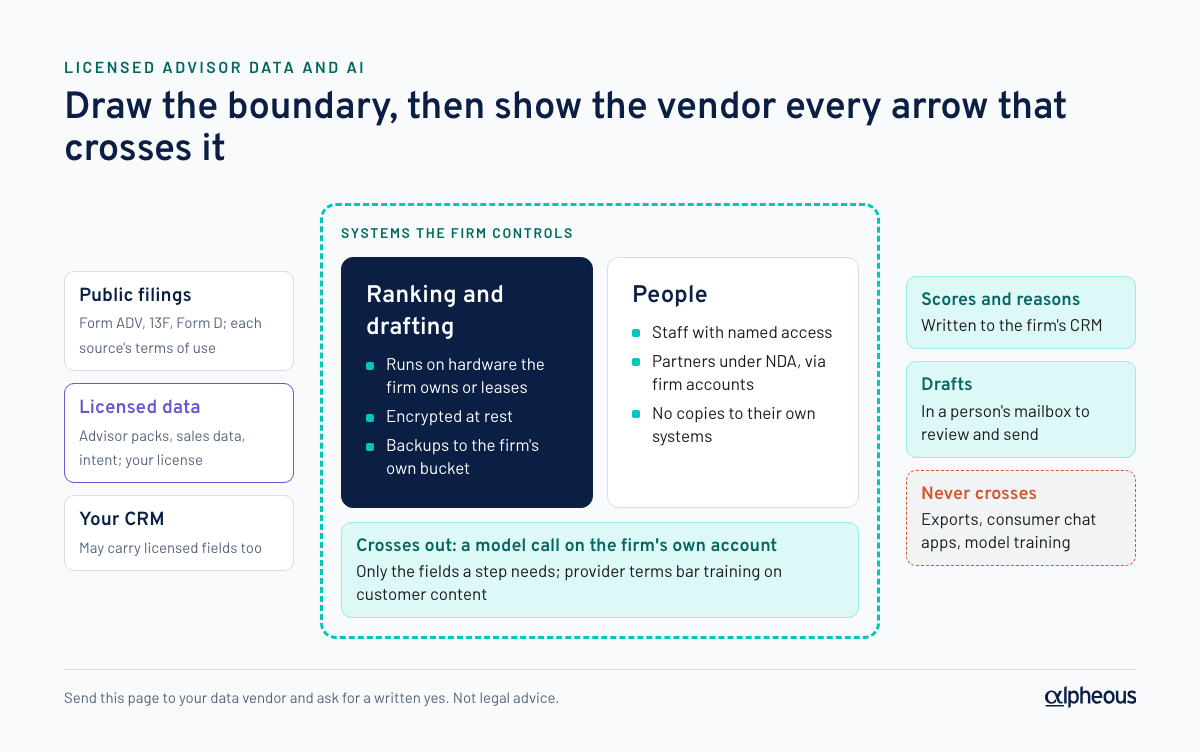
Three arrows leave the box: model calls, scores written to your CRM and drafts in a person's mailbox, each on an account the firm holds. The model call is the one that carries raw licensed fields, so minimize it: send the fields a step actually needs, not whole records, and use tiered model routing so most steps run on smaller inputs. The AI agent security checklist covers the rest of the controls.
What should you ask your data vendor to confirm in writing?
Send the vendor your one-page diagram and ask for written answers to these questions:
- May we use the licensed data as input to AI models (for example Claude or GPT models) through our own commercial account with the model provider?
- Does sending data to a model provider under no-training terms count as a disclosure under our agreement? If yes, what conditions make it acceptable?
- May contractors operate the system inside our environment under NDA, through our accounts?
- Are scores, rankings and drafted emails derived from the data ours to keep? Do they remain licensed data, and what happens to them on termination?
- May derived scores be written into our CRM (for example HubSpot custom properties)?
- Is any model training or fine-tuning permitted? We plan none; confirm that our design does not count as training.
- What must we delete on termination, and does that include indexes, embeddings and backups?
- Are there storage location or security requirements our design must meet?
A written yes to a specific diagram is worth far more than a general reassurance on a call. Keep the answer with the contract.
What should the one-page data-flow diagram show?
Keep it to one page your vendor's counsel can read in two minutes:
- Sources: each dataset, labeled public, licensed or firm-owned.
- The boundary: a box around everything the firm controls, with where it physically runs.
- Every crossing: each arrow that leaves the box, what it carries and under which contract (model provider terms, CRM terms).
- People: employees and contractors inside the boundary, and the agreements that bind them.
- Outputs: what is created (scores, reasons, drafts), where it is stored and who can see it.
- Termination: where data would be deleted from, including backups.
Running a pilot first? Put the diagram in the pilot plan, too; it is one of the first things a data vendor or a CCO will ask for (AI outreach pilot design).
How Alpheous handles licensed data
Alpheous was designed so the firm can draw that boundary tightly:
- A single-tenant appliance on hardware the firm owns, in its own office, one firm per machine.
- Every third-party provider on the firm's own account and billing, including the CRM, the AI model provider and backup storage.
- Encrypted at rest, with credentials in the machine's keychain rather than in files or source.
- Backups to the firm's own bucket, encrypted on the client side before they leave the appliance.
- Model calls logged with model, tokens and latency, and tiered routing so stronger models see only the steps that need them.
- Reasons with every ranking, written into HubSpot alongside the score.
The sub-processor registry and shared responsibility matrix are in the trust center, and the security and compliance page summarizes the setup. Book a call to walk through your data-flow diagram.
FAQ
Can I upload licensed advisor data to ChatGPT or Claude?
Not without checking your license first. Many data licenses bar disclosure to third parties, and a consumer chat app is a third party under its own terms. A business account under no-training terms is a stronger position, but your vendor still needs to agree.
Do AI model providers train on data sent through their APIs?
Under their current business terms, Anthropic says it "may not train models on Customer Content," and OpenAI says it will not use Customer Content to develop or improve its services unless the customer explicitly agrees. Check the current terms for the exact product and account you use.
Is a score built from licensed data a derivative dataset?
It may be, depending on how your license defines derived works. Ask your vendor in writing whether scores, rankings and drafts are yours to keep and whether they survive termination.
Can I use FINRA BrokerCheck data for prospecting?
Read the BrokerCheck terms first. They limit use to listed purposes, such as deciding whether to do business with a firm or person, compliance, and non-commercial investor-protection purposes, and they restrict bulk compiling to investor protection, academic, compliance or regulatory uses.
What is the safest way to use licensed data with AI?
Keep the data on systems your firm controls, run every provider on your own account, let partners work only through your accounts under NDA, copy nothing out and train no models. Then get your vendor's written approval of a one-page diagram of exactly that.
Sources
- BrokerCheck terms of use (brokercheck.finra.org)
- Commercial Terms of Service (anthropic.com)
- Services Agreement (openai.com)

Dave founded Alpheous in 2026 after years of building technology platforms and seeing the same operational bottlenecks across asset management distribution teams.
Dave Ward on LinkedInMore in AI prospecting
AI agent security checklist: rules before CRM and email access
An AI agent security checklist for asset managers: least-privilege CRM scopes, draft-only email, logging, prompt-injection defenses, revocation, vendor proof.
On-premises AI vs cloud: where should an asset manager run AI?
On-premises AI vs cloud for asset managers: weigh control, records, backup, security, cost and upkeep, what to ask about any box, and when your own cloud wins.
How to archive AI-drafted sales emails for SEC and FINRA
Archive AI-drafted sales emails by having a person send them from a firm mailbox your archive already captures, and keep the draft and approval trail.
Alpheous reads the filings every night and ranks who to call next.