FINRA 2210: emails to financial advisors, retail or institutional?
Usually institutional: FINRA Rule 2210 counts registered investment advisers and registered reps as institutional investors unless you expect retail forwarding.
- What are the three types of communication under Rule 2210?
- Who counts as an institutional investor under FINRA Rule 2210?
- Are emails to RIAs institutional communications?
- Are emails to broker-dealer reps and wirehouse advisors institutional?
- What does "reason to believe it will be forwarded" mean?
- How do approval, review and filing differ by category?
- What records do you need to keep?
- Does Rule 2210 apply to every asset manager?
- A classification checklist for advisor email
- How Alpheous supports advisor outreach records
- FAQ
- Sources
In this article
- What are the three types of communication under Rule 2210?
- Who counts as an institutional investor under FINRA Rule 2210?
- Are emails to RIAs institutional communications?
- Are emails to broker-dealer reps and wirehouse advisors institutional?
- What does "reason to believe it will be forwarded" mean?
- How do approval, review and filing differ by category?
- What records do you need to keep?
- Does Rule 2210 apply to every asset manager?
- A classification checklist for advisor email
- How Alpheous supports advisor outreach records
- FAQ
- Sources
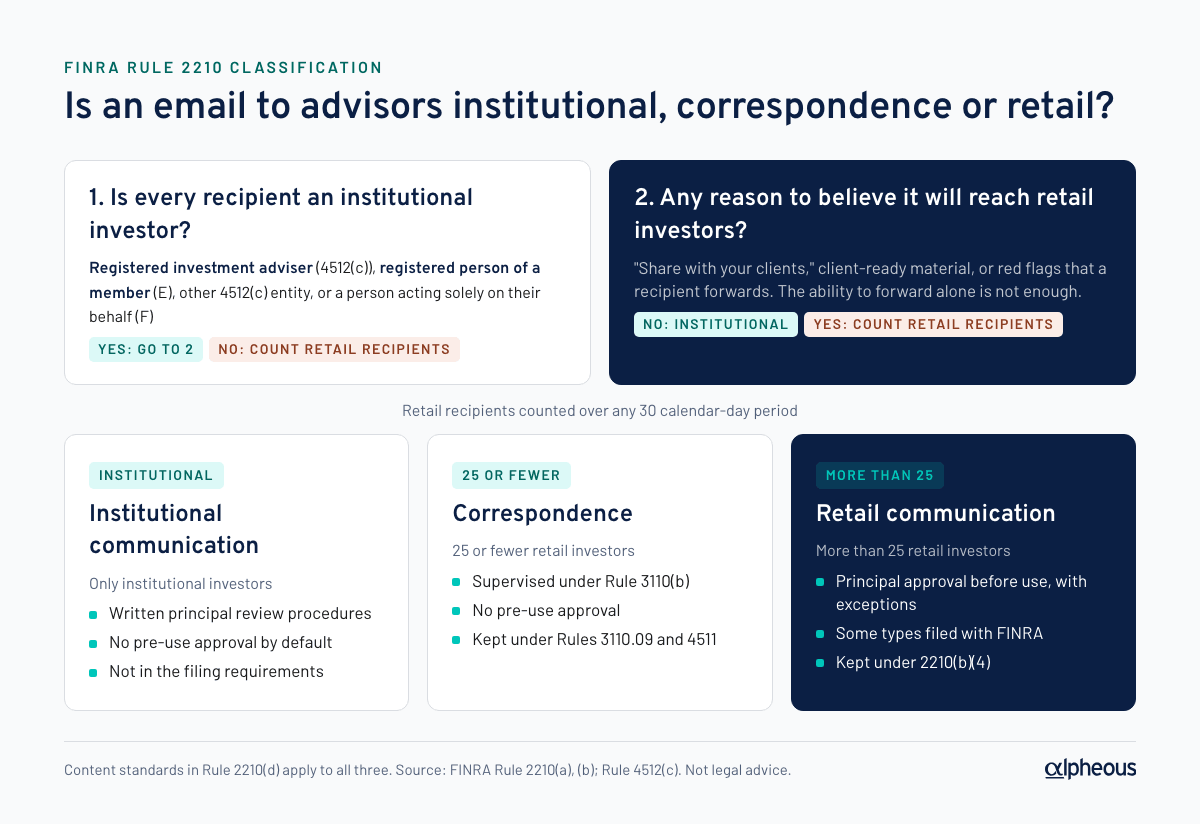
Under FINRA Rule 2210, an email sent only to financial advisors is usually an institutional communication, not a retail one. The rule's definition of "institutional investor" includes registered investment advisers, FINRA member firms and their registered persons, and anyone acting solely on behalf of an institutional investor. Two things break that: a recipient who is not in any institutional category, and any reason to believe the email or an excerpt will be forwarded to retail investors.
This is not legal or compliance advice. It reads the rule text; your CCO decides how your firm applies it.
What are the three types of communication under Rule 2210?
Rule 2210(a) defines them by audience:
- Correspondence: any written (including electronic) communication "distributed or made available to 25 or fewer retail investors within any 30 calendar-day period."
- Retail communication: the same, but to "more than 25 retail investors within any 30 calendar-day period."
- Institutional communication: distributed or made available "only to institutional investors," excluding a member's internal communications.
A "retail investor" is "any person other than an institutional investor, regardless of whether the person has an account with a member." So the whole question turns on the institutional investor definition.
Who counts as an institutional investor under FINRA Rule 2210?
Rule 2210(a)(4) lists six categories. An institutional investor is any:
| Paragraph | Category | What it means for distribution teams |
|---|---|---|
| (A) | Person described in Rule 4512(c), whether or not it has an account with a member | Banks, savings and loans, insurance companies, registered investment companies, investment advisers registered with the SEC or a state, and any other person with total assets of at least $50 million |
| (B) | Governmental entity or subdivision | Public pensions and agencies |
| (C) | 403(b) or 457 plans with at least 100 participants in aggregate | The plan, not its participants |
| (D) | Qualified plans with at least 100 participants in aggregate | The plan, not its participants |
| (E) | Member or registered person of such a member | Broker-dealers and their registered reps |
| (F) | Person acting solely on behalf of any such institutional investor | Employees acting for an institutional firm |
The rule then adds the caveat that matters most: "No member may treat a communication as having been distributed to an institutional investor if the member has reason to believe that the communication or any excerpt thereof will be forwarded or made available to any retail investor."
Are emails to RIAs institutional communications?
Generally, yes. Rule 4512(c)(2) covers "an investment adviser registered either with the SEC under Section 203 of the Investment Advisers Act or with a state securities commission." An email to an RIA reaches an institutional investor under 2210(a)(4)(A), and the advisors and analysts reading it on the firm's behalf fall under (F), "person acting solely on behalf of any such institutional investor."
Two words do work here. Registered: an adviser that is not registered with the SEC or a state, such as an exempt reporting adviser, does not fit the 4512(c)(2) prong and has to qualify another way, for example the $50 million total assets test in 4512(c)(3). Solely: the person must be acting for the institution. Our reading is that an email to an advisor about their own personal portfolio is not that; ask your CCO where your firm draws the line.
If you are building the RIA list from public filings, Form ADV prospecting shows where registration status and assets live.
Are emails to broker-dealer reps and wirehouse advisors institutional?
Generally, yes, through a different door. Rule 2210(a)(4)(E) covers a "member or registered person of such a member." A financial advisor at a wirehouse, a regional broker-dealer or an independent broker-dealer is typically a registered person of a FINRA member, so a wholesaler's email to them is institutional, subject to the forwarding caveat. The firm itself is a member, so emails to its home-office research or product teams are institutional too.
Dually registered advisors usually qualify on both counts. The hard cases are the edges of a list:
- Unregistered "advisors": insurance-only agents, unregistered financial planners and CPAs are not registered persons of a member and not registered advisers. Unless another category fits, they are retail investors.
- Former reps: a person whose registration lapsed is no longer a registered person. A stale CRM record can turn an institutional list into a mixed one, so check registration against current data (and see licensed data and AI tools before you feed a vendor dataset to a model).
- Mixed lists: one retail recipient means the email is not "distributed or made available only to institutional investors." Count the retail recipients to see whether it is correspondence or a retail communication.
What does "reason to believe it will be forwarded" mean?
FINRA's Rule 2210 FAQ, updated December 22, 2025, answers three practical questions:
- Can you send institutional email if recipients could forward it? Yes. "The recipient's ability to forward a communication by email or other means does not by itself constitute a 'reason to believe'" it will be forwarded to a retail investor. FINRA still says firms should have procedures reasonably designed to prevent forwarding, which may include a legend marking the communication for institutional investor use only.
- What if a recipient forwards it anyway? Unless the firm becomes aware of the forwarding, or did not adequately label the communication, it does not have to treat it as retail.
- What if you learn they do? The firm must treat future communications to that institutional investor as retail until it reasonably concludes the practice has stopped, and must follow up on red flags.
The obvious red flag is your own content. An email with a "client-ready" one-pager, a fund summary written for end investors, or the words "feel free to share with your clients" gives you reason to believe it will reach retail investors. Treat that content as retail from the start.
How do approval, review and filing differ by category?
| Correspondence | Retail communication | Institutional communication | |
|---|---|---|---|
| Pre-use principal approval | Not required | Required before the earlier of use or filing, with exceptions in 2210(b)(1)(C) and (D) | Not required by default |
| Review | Supervised under Rules 3110(b) and 3110.06 to .09 | Principal approval is the review | Written procedures for principal review; if not all are pre-reviewed, training, documentation and surveillance |
| FINRA filing | Not in the filing requirements | Some types must be filed, before or within 10 business days of first use (2210(c)) | Not in the filing requirements |
| Content standards (2210(d)) | Apply | Apply | Apply |
| Records | Rules 3110.09 and 4511 | 2210(b)(4)(A) | 2210(b)(4)(A) |
The content standards row is the one teams forget. Institutional does not mean unregulated: every communication must be fair and balanced, may not be "false, exaggerated, unwarranted, promissory or misleading," and may not predict or project performance. An AI drafting tool that writes for advisors needs the same claim checks as one writing for retail. FINRA's FAQ D.8 says firms are responsible for AI-generated communications just as for human-written ones. For template design, see Can AI personalize a compliance-approved email template?
What records do you need to keep?
For retail and institutional communications, Rule 2210(b)(4)(A) requires keeping them for the retention period in SEC Rule 17a-4(b), with a copy of the communication, dates of first and last use, the approving principal and date (if any), the preparer's name where it was not pre-approved, and the source of any statistics or charts. Correspondence is kept under Rules 3110.09 and 4511.
SEC Rule 17a-4(b)(4) requires broker-dealers to preserve copies of communications sent "(and any approvals thereof)" relating to the business, for not less than three years, the first two in an easily accessible place. If AI drafted the email, the draft, its sources and the review decision belong in that record; see archiving AI-drafted emails.
Does Rule 2210 apply to every asset manager?
Rule 2210 governs communications of FINRA member firms and their associated persons. At most asset managers, wholesalers are registered representatives of an affiliated or third-party distributor, which is a member, so 2210 applies to their email. An asset manager's advisory entity communicating as an adviser is subject to the SEC's Marketing Rule, a separate analysis this post does not cover.
A classification checklist for advisor email
- Tag each contact with a basis: RIA (SEC or state), registered person of a member, other 4512(c) entity, or none.
- Verify registration against current public data before a campaign, not once a year.
- Treat anyone without a basis as a retail investor.
- Split mixed lists, or treat the send as correspondence or a retail communication.
- Add an institutional-use legend to institutional templates.
- Keep end-investor material out of institutional emails, or route it through retail approval.
- Record forwarding red flags on the account and switch that recipient to retail treatment.
- Apply the 2210(d) content checks to every email, institutional or not.
- Keep each email, its approvals and its sources for the 17a-4(b) period.
Running an AI pilot against advisor lists? Build these checks into the gates of your AI outreach pilot design, and see the AI agent security checklist and on-premises AI vs cloud for where the drafting model and data should live.
How Alpheous supports advisor outreach records
Alpheous ranks advisors and firms for distribution teams and shows the reasons each one ranked, with scores and reasons written into HubSpot. It never sends on its own: drafts land in the rep's mailbox drafts or an approval queue, fail-closed and off by default. Every action touching communications records who, what and when, drafts carry a review status, and records stay on the firm's own appliance and can be exported. Classification decisions remain your compliance team's. Take the tour or book a call.
FAQ
Is an email to a registered investment adviser an institutional communication?
Usually. Rule 2210(a)(4)(A) includes persons described in Rule 4512(c), which covers investment advisers registered with the SEC or a state, and (F) covers people acting solely on their behalf. It is not institutional if you have reason to believe it will be forwarded to retail investors.
Are wirehouse financial advisors institutional investors under FINRA 2210?
Generally yes, if they are registered persons of a FINRA member: Rule 2210(a)(4)(E) covers a "member or registered person of such a member." Unregistered staff and insurance-only agents do not qualify that way.
What is the difference between correspondence and a retail communication?
Correspondence goes to 25 or fewer retail investors within any 30 calendar-day period and needs supervision but not pre-use principal approval. A retail communication goes to more than 25 retail investors in that window and needs principal approval before use, unless an exception applies.
Do institutional communications need principal approval?
Not necessarily before use. Rule 2210(b)(3) requires written procedures for principal review; if they do not require review of every institutional communication before first use, they must include training, documentation and surveillance.
Does a "for institutional use only" legend make an email institutional?
No; the recipients do. FINRA's FAQ says legends are a reasonable part of procedures to prevent forwarding, but if you know or have red flags that a recipient forwards to retail investors, you must treat communications to them as retail.
How long must broker-dealers keep emails to advisors?
SEC Rule 17a-4(b)(4) requires at least three years for communications sent relating to the business, the first two in an easily accessible place. Rule 2210(b)(4) adds what the record must contain for retail and institutional communications.
Sources
- Rule 2210(a) (finra.org)
- Rule 4512(c) (finra.org)
- Rule 2210 FAQ (finra.org)
- SEC Rule 17a-4(b)(4) (ecfr.gov)
- Marketing Rule (ecfr.gov)

Dave founded Alpheous in 2026 after years of building technology platforms and seeing the same operational bottlenecks across asset management distribution teams.
Dave Ward on LinkedInMore in Regulatory signals
The SEC registration threshold for RIAs is a sales trigger
The SEC registration threshold is $100M-$110M of RAUM. Learn the exact rule, the 90-day and 180-day clocks, and how to spot advisers about to cross it.
Form ADV prospecting: how to find prospects at RIAs and funds
A practical guide to Form ADV prospecting: which Schedule D and Part 1A items reveal a fund's administrator, auditor and custodian, and how to use them.

AI outreach pilot design for asset management distribution
Run an AI outreach pilot without booking meetings nobody can take: gates before the first send, a weekly meeting cap, a locked holdout and a 90-day decision.
Alpheous reads the filings every night and ranks who to call next.